
Pizza base is pale and floppy
By ThePizzaPlanet.com · Updated
The short answer
The surface of your base never got hot enough for long enough to brown. Bake on a fully preheated steel at maximum, bake it longer than feels right, and switch to a malted bread flour or add 1–2% sugar so there is something there to brown.
Skip to the fix ↓Top pick
What you're seeing
The pizza is cooked — the cheese has melted, the dough is not raw — but it looks unfinished. The base is blond all over, with none of the mottled brown patches you were hoping for, and the rim has the colour of a dinner roll rather than a pizza crust. Pick up a slice and it folds flat over your hand instead of holding out straight. The texture is the real tell: it is dry and papery rather than crisp, which means it lost its moisture without ever developing a crust.
The short answer
The surface of the dough never reached the temperature that browning needs, so there was nothing to be crisp about. Get a steel or stone properly preheated, bake hotter and longer than feels comfortable, and give the dough something to brown with — a malted bread flour, or 1–2% sugar on flour weight. Colour and structure arrive together; you cannot get one without the other.
Why it happens
Browning has a temperature threshold, not a time threshold
The Maillard reaction — amino acids and reducing sugars combining into the hundreds of compounds that make bread crust taste like bread crust — runs meaningfully only when the surface gets well above 150 °C (300 °F). Caramelisation of sugars needs a similar push. Below that, you can bake all day and produce nothing but a dry, pale biscuit.
The obstacle is water. While the surface still holds moisture it is locked at 100 °C (212 °F), because every joule going in is spent on evaporation. Only once a spot has dried does its temperature climb into browning range, so the sequence is always dry, then brown, then crisp. A pale base has not got past step one fast enough; a floppy one has not got past it at all — the slice droops because there is still water in it, which is the same failure that produces a soggy centre under a heavier load.
Your slab is not as hot as your oven says
Home ovens cap out at 250–290 °C (480–555 °F), and the number on the dial describes the air. A stone or steel needs 45–60 minutes after the oven reaches temperature to catch up; give it 20 minutes and it can still be 60–80 °C behind. Launch onto that and the first 90 seconds — the window where a base either dries or does not — are wasted.
Material matters as much as time. Carbon steel conducts at roughly 45 W/m·K against cordierite's 2.5, about 18 times faster, so a baking steel at 250 °C drives far more energy into the dough in those first seconds than a stone at the same temperature. When your ceiling is fixed by the oven, conduction is the one variable still available to you.
The flour has nothing to brown with
This is the cause people miss, and often the biggest. Italian 00 flour is generally unmalted, and it is milled for a 60–90 second bake at 430–480 °C (800–900 °F), where the surface dries and browns almost instantly. Drop the same flour into a 250 °C (480 °F) oven for 7 minutes and there are not enough free sugars at the surface for the reaction to work with.
North American bread flours are usually enzyme-active (malted barley flour or added enzyme) — the mill adds a little amylase, which breaks starch into the reducing sugars Maillard needs. King Arthur Bread Flour at around 12.7% protein browns readily at home temperatures and holds a slice out straight rather than letting it flop. Our bread flour against 00 comparison covers the trade in both directions.
The bake was too short, or over-floured
Neapolitan timings do not transfer. A home-oven pizza wants 6–9 minutes, not 3, and pulling it when the cheese melts is several minutes early. A thick layer of dry bench flour makes it worse: it insulates the dough from the slab and soaks up moisture leaving it.
Fix it now
- Preheat the slab for 45–60 minutes at maximum, timed from when the oven reaches temperature. Upper-middle rack.
- Bake longer than you think. Set a timer for 7 minutes and check the underside with a peel rather than trusting the top. Colour on the base is what you are waiting for.
- Finish under the grill. The last 90 seconds with the grill element on drives the top and the rim past the point where the cheese alone would have told you to stop.
- Knock the excess flour off before launching. Lift the dressed base at one edge and give the peel a sharp shake; anything loose should fall away. Use semolina rather than plain flour, and use it sparingly.
- Bake one at a time. Two pizzas share the same stored heat and double the steam in the cavity — both work directly against browning.
- Rest on a wire rack for 2 minutes. A crisp base put onto a board immediately steams itself soft again from underneath.
- If tonight's dough is 00 and already mixed, push the grill hard rather than extending the bake. A soft 00 in a slow oven only dries out; the colour you get will come from the top heat.
Prevent it next time
- Use a malted bread flour around 12.5–13% protein for home ovens. It browns at temperatures where 00 will not, and it carries a slice without folding.
- Add 1–2% sugar on flour weight if you are staying with 00 and baking below 290 °C (555 °F). Above that it will scorch — that is the burnt-base trade in the other direction.
- A little oil helps too. 2–3% olive oil conducts heat into the surface and gives a crisper, more tender base in a slow oven — which is why a New York supreme dough carries it and a Neapolitan one does not. Set the ratios with the New York calculator.
- Hydration down slightly for home ovens. 60–63% dries faster at the surface than 68% does, and gets to browning temperature sooner.
- Keep the toppings light. Water on top is the enemy of colour underneath.
- Preheat is not optional. An hour of electricity is the difference between a pizza and a warm bread disc.
- Judge doneness by the underside. Lift and look every time until you know your oven; the top is a poor witness.
- Know what the oven itself is costing you. A domestic ceiling caps how fast a base can dry — our honest home-oven guide covers what more heat actually buys and who should skip it.
What you might need
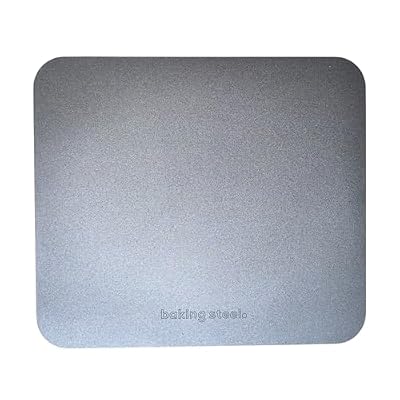
Original Baking Steel
A pale base is a heat-transfer problem, and steel moves heat into dough about 18× faster than cordierite (~45 W/m·K against ~2.5) — in a home oven capped at 250 °C it is the difference between blond and browned.
i
Product prices and availability are accurate as of the date/time indicated and are subject to change. Any price and availability information displayed on Amazon.com at the time of purchase will apply to the purchase of this product.Put it into practice
Quick questions
Why is my pizza crust pale even after a long bake?
Browning is a surface-temperature reaction, not a time reaction. The dough surface has to get well above 150 °C (300 °F) for the Maillard reaction to run, and while the base is still wet it is pinned at 100 °C (212 °F). A long bake in a cool oven simply dries the pizza out at low temperature — you get cardboard rather than colour.
Is 00 flour bad for home ovens?
Not bad, but mismatched. Italian 00 is typically unmalted and is formulated for 60–90 seconds at 430–480 °C (800–900 °F), where it browns beautifully. In a 250 °C (480 °F) domestic oven there is less sugar available and no fierce heat to force the reaction, so it stays pale. A malted bread flour around 12.7% protein browns far more readily at home.
Should I add sugar to pizza dough?
For a home oven, yes — 1–2% of flour weight gives the crust something that caramelises well below the temperature plain starch needs. Skip it if you are baking above about 300 °C (570 °F), where the same sugar will scorch the base before the toppings are ready.
Related problems
Get the right measurements
Most dough problems start with bad ratios. Use our calculator for exact measurements.