
Pizza crust is dense and bready, not chewy
By ThePizzaPlanet.com · Updated
The short answer
Dense crust means the gas never got in or never got out of the dough into the crumb. Proof to the peak, keep the rim untouched, stop adding bench flour, and bake on a surface hot enough to give you real oven spring.
Skip to the fix ↓Top pick
What you're seeing
You cut a slice and the crumb is tight — small, even holes or no holes at all, more like a sandwich loaf than a pizza. The rim looks the right size but eats heavy, and the base is stiff rather than chewy: it snaps or it drags, but it does not stretch when you pull a bite. The flavour is fine and slightly bready, which is the giveaway. This is not a burnt pizza or a raw pizza. It is a correctly baked pizza made from dough that never got the gas structure that makes a crust chewy.
The short answer
Chew is gas trapped inside a hydrated, developed gluten network and then expanded fast by heat. You lose it in one of four places: the dough did not ferment to its peak, you pushed the gas out during shaping, the hydration was too low to make steam, or the baking surface was not hot enough to give oven spring. Work through them in that order.
Why it happens
The dough was under-proofed
Fermentation does two things at once — it inflates the dough with carbon dioxide and it softens the gluten so the network can expand. Cut it short and you have a dense, tight ball going into a hot oven, and no oven can put gas into dough that has none. Judge by state, not time: you want 50–70% growth in bulk, a domed ball, and a poke that fills back in slowly and incompletely. If the ball has barely moved at all, that is a dough that did not rise and the fix is upstream.
The opposite end looks similar on the plate. An over-proofed dough has spent its gas and lost its structure, and it also bakes flat and heavy. Check the smell: sharp alcohol means you went past the peak, not short of it.
You pressed the gas out
Everything you do between the container and the peel either preserves bubbles or destroys them. A rolling pin destroys them — that is what it is for. So does pressing the outer rim flat, slapping the disc hard on the bench, and stacking heavy toppings onto a thin centre. Those bubbles are the crumb; once they are out, the oven cannot put them back. Open the ball with fingertips from the centre outwards and leave the outer 1.5 cm completely untouched, then stretch with gravity over your knuckles.
The hydration was too low, or the bench flour raised it back up
Water does more than hydrate. During the bake it turns to steam, and that steam is what inflates the existing bubbles into an open crumb; it also gelatinises starch, which is a large part of what chewy actually means. Below about 58% hydration there simply is not enough of it. Set the ratio deliberately with the Neapolitan calculator rather than by feel.
Then watch what you add. Working an extra 60 g of bench flour into a 1000 g dough drops a 65% dough to 61% without you noticing, which is exactly the wrong direction. If the dough feels too sticky to handle, the answer is wet hands and a scraper, not flour.
The baking surface was too cool for oven spring
Oven spring is the burst of expansion in the first 60–90 seconds, when trapped gas expands with heat and water flashes to steam, before the crust sets. It is driven almost entirely by how fast heat enters the base. A thin aluminium tray at 250 °C (480 °F) holds very little energy and dumps it slowly; a 6 mm steel plate at the same temperature holds far more energy and moves it into the dough roughly 18 times faster than cordierite ceramic. That difference is the difference between a base that springs and a base that dries out slowly into a bread roll. The steel versus stone comparison covers the trade-offs.
Fix it now
- Proof to the state, not to the timer. 50–70% growth, domed, slow to fill a dent. If it is not there, give it another 45–60 minutes somewhere at 24 °C (75 °F).
- Put the rolling pin away. Fingertips from the centre out, rim untouched, then knuckle-drape and rotate.
- Shake off the excess flour before you launch. Hold the disc up and let the loose flour fall. Only a thin film of semolina should reach the peel.
- Preheat the steel or stone for 45–60 minutes at maximum. The oven reaching temperature and the steel reaching temperature are 40 minutes apart; the thermostat only knows about the air.
- Bake hot, top rack. With a steel 15–20 cm below the top element, 250–290 °C (480–555 °F) for 6–8 minutes gives a base that puffs. Lower and slower dries it.
- Keep the toppings light. A wet, heavy load weighs the centre down through exactly the minute when the base needs to expand.
Prevent it next time
- Hydrate at 62–65% minimum for a hand-stretched crust, and weigh the water rather than pouring it.
- Cold ferment 24–48 hours. Longer fermentation means more gas nuclei, softer gluten and a more open crumb, and it makes a Margherita taste of something.
- Use a flour with enough strength to hold the gas. A W300–320 flour like Caputo Chef's keeps its bubble structure across a 24–48 hour ferment where a weak all-purpose flour lets it collapse. The red-bag Caputo Pizzeria at W260–280 is a shorter-ferment flour — fine at 8–24 hours, not for two days.
- Ball for the size you are making. 250 g for a 30 cm Neapolitan, 310 g for a New York slice — over-heavy balls press out thick and bake dense in the middle.
- Bake on steel and preheat it properly. It is the one equipment change that reliably fixes a dense base, and it fixes nothing at all if you give it 20 minutes.
- Rest the baked pizza 2 minutes before cutting. Steam redistributes and the crumb sets chewy rather than gummy.
What you might need
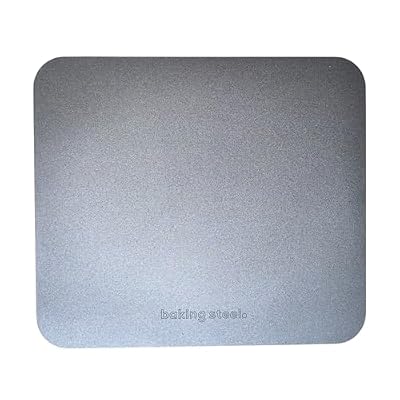
Original Baking Steel
Oven spring depends on how fast heat enters the base in the first 60 seconds, and steel conducts heat roughly 18 times faster than a ceramic stone at the same temperature.
Read our full review →Put it into practice
Quick questions
Why is my pizza crust bready instead of chewy?
Chew comes from a well-hydrated, well-developed gluten network that has been expanded by gas. If the dough was under-proofed, degassed with a rolling pin, or baked on a cool surface, the crumb stays tight and eats like bread.
Does hydration affect how chewy pizza crust is?
Strongly. Below about 58% there is not enough water to gelatinise starch properly or to turn into the steam that opens the crumb, so the crust bakes dry and dense. 62–65% is the practical floor for a chewy base.
Should I use a rolling pin on pizza dough?
Not if you want a puffed rim. A pin presses out the gas bubbles you spent hours creating, and they do not come back in the oven. Press and stretch by hand and leave the outer 1.5 cm alone.
Related problems
Get the right measurements
Most dough problems start with bad ratios. Use our calculator for exact measurements.