
Outdoor Pizza Ovens: Gas, Wood or Pellet — Choosing by Fuel, Space and Budget
By ThePizzaPlanet.com · Updated
Top pick
What actually matters
An outdoor oven buys one thing a kitchen cannot: floor heat well above what a domestic thermostat will ever reach. Which model is worth it to you comes down to four published numbers — fuel and how much of it a bake costs, the pizza size the stone supports, how the oven behaves outside the mild weather it was photographed in, and whether your fuel and your flame are even allowed where you live. Every figure below is the maker's own; where a spec sheet does not state a number, that cell says so rather than guessing at one. If you are still weighing an outdoor oven against a kitchen electric one, indoor vs outdoor pizza oven lines up the two categories side by side.
Fuel: gas, wood, charcoal or pellet
Four of the six ovens here — the Koda 2, Koda 16, Arc XL and Pi Prime — run on propane alone. The Karu 12 ships for wood and charcoal, with Ooni's own gas burner sold as a separate attachment if you want the third option later. The Ninja Woodfire is the odd one out: it is an electric multi-cooker, heated by a standard outlet, with wood pellets added through a hopper purely for flavor rather than as the heat source.
Only one maker in this group publishes a number you can turn into a cost per bake. Solo Stove states that a standard 20 lb propane tank runs the Pi Prime for up to 20 hours on its highest setting — a burn rate of about 1 lb of propane per hour. The Pi Prime's own stated preheat is 15 minutes, and Solo Stove's own figure for turning out a pizza once lit is as little as 90 seconds, so a single bake of roughly 16–17 minutes end to end works out to a little over a quarter pound (around 0.12–0.13 kg) of propane. Multiply that by your local propane price per pound to get what a single pizza actually costs you to fire.
Neither Ooni (Koda 2, Koda 16) nor Gozney (Arc XL) publishes a comparable burn rate, so no honest per-bake figure can be given for any of them — a propane oven's dial position changes consumption enough that a single number would be a guess dressed up as a spec, and this page does not estimate what a maker has not stated. The Karu 12's wood and charcoal consumption is likewise never quantified by Ooni; how much fuel a wood fire burns depends on species, moisture and how hard you run it, in a way a spec sheet cannot capture, which is also why buying wood or charcoal by weight for a season is closer to guesswork than buying propane by the tank. The Ninja Woodfire draws 1,700 W on household power, but SharkNinja publishes no preheat time to multiply that wattage by, so a kWh-per-bake figure is not something this page can responsibly hand you either.
Fuel also decides how much attention the oven needs while it runs. A propane burner is a dial: turn it on, wait for the stone, launch. Wood and charcoal need tending — where the coals sit, when to add fuel, how hard the flame licks the dome — and that is a skill in its own right, not a setting. The Karu 12 is the only oven here that asks for it by default, with Ooni's gas burner available afterward if the live fire turns out not to be what you wanted.
12 or 16 inch
The six ovens split across four pizza sizes: the Karu 12 and the Ninja Woodfire both cap out at 12 inches, the Pi Prime's front opening is 13 inches, the Koda 2 handles up to 14, and the Arc XL and Koda 16 both reach a full 16 inches. A bigger stone does not automatically mean a bigger, heavier oven — construction matters as much as pizza size. The Arc XL is the heaviest oven here at 26.5 kg, in line with its 16-inch stone, but the Koda 16 matches that same 16 inches at a lighter 18.2 kg, while covering more counter area than the Arc XL at 63 x 58 cm against the Arc XL's 53 x 62.9 cm. At the small end, the electric Ninja Woodfire is nearly twice the Karu 12's weight at 22.4 kg against 12 kg, despite capping out at the same 12-inch pizza.
The honest trade is simple: a 16-inch deck means you can feed a larger group per bake and has more room for error when you launch a stretched disc slightly off-centre, but it costs you counter or table space and a harder lift. If you are cooking for two, the smaller ovens are not a compromise; if you host regularly, the extra inches buy you fewer trips back to the dough tray.
Wind and cold
A gas flame is an open flame, and wind moves heat away from the stone faster than the burner can replace it, so a breezy table will typically take longer to reach the same floor temperature than a sheltered one does, sometimes considerably longer. None of these ovens publish a windproofing rating, so the only honest guidance is to set up somewhere sheltered and expect preheats to run past the stated figure on a gusty day.
Cold weather works against you the same way, for the same reason: the oven is losing heat to a colder surrounding air throughout the preheat, not just at the moment you light it, so the gap between "on" and "ready" stretches in winter. A heavier, more insulated body loses that race more slowly than a thin-walled one, which is one more reason the published weight figures above are worth reading before buying for a climate with a real winter. Between sessions, covering an oven left outdoors protects it from rain and temperature cycling; check what each maker sells or recommends for that specific model rather than assuming one cover fits all of them. The lighter ovens on this page — the Karu 12 at 12 kg and the Pi Prime at 13.6 kg — are also the easiest to move indoors or into a shed between bakes, which sidesteps the cover question entirely at the cost of carrying a warm oven somewhere once you are done with it. Will wind blow out the flame and using an outdoor oven in winter and rain both go deeper on setup, preheat and protecting the oven itself in exactly these conditions.
Where you are allowed to use it
Before anything else on this page, check your own situation: many apartment leases, condo bylaws and local fire codes restrict or ban open flames and bottled gas on balconies and shared outdoor space, and the rules vary by building and by city. An oven that is perfectly legal in a detached backyard can be a lease violation two floors up, so this is worth confirming before you buy rather than after — can you use a pizza oven on an apartment balcony covers what the common fire-code rule actually says, how to check your own building, and the electric fallback if the answer is no. Smoke is a separate question from where you're allowed to fire an oven at all — will smoke from a pizza oven bother your neighbors covers how fuel choice and wind direction decide it.
Head-to-head comparisons
Down to two specific ovens from this page? These side-by-side comparisons line up every published figure for each pair alone:
- Ooni Koda 2 vs Koda 16: 14 or 16 inch?
- Ooni Koda 2 vs Karu 12: gas or multi-fuel?
- Ninja Woodfire vs Ooni Koda 2: electric or gas outdoors?
- Solo Stove Pi Prime vs Ooni Koda 2: which propane oven?
- Gozney Arc XL vs Ooni Koda 16: which 16-inch oven?
The picks
The table below lays out every published figure side by side — fuel, maximum temperature, preheat, pizza size, weight and footprint — exactly as each maker states it. The cards underneath carry the reasoning for each pick.
| Model | Fuel | Floor temp | Max temp (maker’s figure) | Preheat | Pizza size | Weight | Footprint (W × D × H) | Fuel kit sold separately | Source |
|---|---|---|---|---|---|---|---|---|---|
| Ooni Koda 2 Gas Pizza Oven | gas | not published | 510 °C (950 °F) | not published | 14 in | 16 kg (35 lb) | 54.5 x 47.2 x 33.3 cm | No | Maker’s page |
| Gozney Arc XL | gas | not published | 500 °C (932 °F) | not published | 16 in | 26.5 kg (58 lb) | 53 x 62.9 x 34.2 cm | No | Maker’s page |
| Ooni Karu 12 Multi-Fuel Pizza Oven | wood / charcoal / gas | not published | 500 °C (932 °F) | 15 min | 12 in | 12 kg (26 lb) | 40 x 80 x 77 cm | Yes | Maker’s page |
| Ninja Woodfire Outdoor Oven (OO101) | electric / pellet | not published | 371 °C (700 °F) | not published | 12 in | 22.4 kg (49 lb) | 51 x 61 x 46 cm | No | Maker’s page |
| Solo Stove Pi Prime | gas | not published | 510 °C (950 °F) | 15 min | 13 in | 13.6 kg (30 lb) | 52.1 x 52.1 x 39.4 cm | No | Maker’s page (archived) |
| Ooni Koda 16 Gas Pizza Oven | gas | not published | 500 °C (932 °F) | 20 min | 16 in | 18.2 kg (40 lb) | 63 x 58 x 37 cm | No | Maker’s page |
Top pick

Ooni Koda 2 Gas Pizza Oven
Reaches a stated 510 °C (950 °F) with a plug-and-play setup Ooni says takes minutes.
Check price on Amazon →Upgrade

Gozney Arc XL
Matches the Koda 16's 16-inch capacity, and the heaviest build here at 26.5 kg; Gozney publishes no preheat time for it.
Check price on Amazon →Also considered

Ooni Karu 12 Multi-Fuel Pizza Oven
The only wood-and-charcoal oven on this page, and the lightest at 12 kg, with a stated 15-minute preheat; Ooni's gas burner is sold separately.
Check price on Amazon →Also considered

Ninja Woodfire Outdoor Oven (OO101)
An 8-in-1 electric outdoor cooker where pizza is one of eight functions, plugging into a standard outlet rather than running on propane or wood.
Check price on Amazon →Also considered

Solo Stove Pi Prime
The only oven here with a published propane burn time, a stated 15-minute preheat and a maximum above 510 °C (950 °F).
Check price on Amazon →Also considered
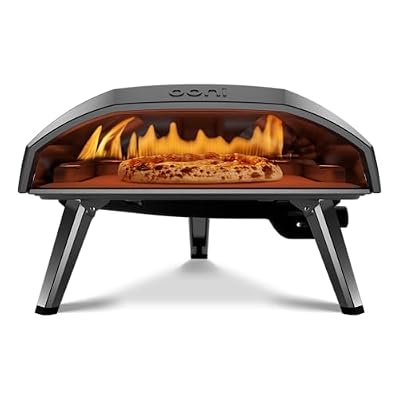
Ooni Koda 16 Gas Pizza Oven
Matches the Arc XL's 16-inch capacity at a lighter 18.2 kg, with Ooni's own stated 20-minute preheat.
Check price on Amazon →
How we chose
Every number above comes from a manufacturer product page, spec sheet or owner's manual, linked from each row as "Maker's page" — there is no model here we can honestly claim to have tested, because this site owns no ovens and runs no product trials. Where a maker gives a single combined temperature rather than separate floor and air readings, this page reports that one number and marks the floor column "not published" rather than assuming the two are the same.
The Pi Prime's propane burn rate is the one figure on this page that turns directly into a running cost, which is why it earns a specific call-out in the fuel section above: it is the only oven in this group whose maker states how long a tank lasts. Every other fuel figure here is either unpublished or, for wood and charcoal, not practically quantifiable from a spec sheet at all.
The Ninja Woodfire sits in the also-considered row because it answers a different question than the rest of the table. It is a general-purpose electric outdoor cooker — roast, bake, smoke, dehydrate — where pizza is one of eight modes rather than the reason the appliance exists, and it should be judged as a multi-cooker that also bakes a pizza, not as a dedicated pizza oven competing on floor temperature.
If this goes wrong
No leopard spotting, or a soggy centre. Outdoor ovens heat the dome of the chamber faster than the stone underneath it, so a flame that has been running for the full preheat time can still sit on a floor that has not caught up — launch onto that floor and you get a pale, underbaked base under a dome that looks plenty hot. Give the stone the full preheat time stated for your model before the first pizza goes in, and read no leopard spotting on the crust for what the floor actually needs to produce real charring.
One side burns before the other. Every gas or wood-fired oven here — the Koda 2, Koda 16, Arc XL, Karu 12 and Pi Prime — has its flame or firebox on one side rather than distributed evenly around the chamber, so a pizza left still for the whole bake chars on the near side and stays pale on the far one. At a 60–90 second bake this happens fast: turn the pizza a quarter turn every 20–30 seconds rather than waiting for a single midpoint rotation, and see pizza cooks unevenly for why outdoor ovens need that much more frequent a turn than a kitchen oven does. The electric Ninja Woodfire is the exception: SharkNinja's own spec for its Neapolitan-style setting is a 3-minute, no-turn bake, because the heat comes from enclosed elements rather than an open flame confined to one side.
Who should skip this
- You can't use an open flame or bottled gas where you live — check your building's rules before anything else.
- You'd fire it fewer than about ten times a year; a steel in your kitchen oven covers most of what you'd bake.