
Pizza steels: choosing a baking surface for a home oven
By ThePizzaPlanet.com · Updated
Top pick
What actually matters
Three properties, in this order: what the surface is made of, how thick it is, and whether it fits your oven.
Material decides the base, and it does so before any brand does. Carbon steel conducts at roughly 45 W/m·K; cordierite, the ceramic almost every pizza stone is made from, sits near 2.5 — about eighteen times slower. That ratio matters because of the ceiling above it: a domestic oven reaches 250–290 °C (480–555 °F) and no purchase moves that number, so the only remaining lever on the base is how fast the heat you already have crosses into cold, wet dough. The full material comparison, stones included, is set out in pizza steel vs pizza stone; this page is the purchase that follows from it.
Thickness is a way of writing down mass, and mass is what you actually spend money on. A thicker plate stores more energy and gives it back across more pizzas; a thinner one heats sooner and runs out faster. The rule that follows is not "buy the thickest": it is buy the thickest plate you can move safely, because you will be lifting it in and out of an oven at full temperature. Around 6 mm (1/4 in) is where that lands for most people — a plate of that thickness in a normal home footprint already weighs the better part of seven kilos and needs both hands and real care. Go heavier only if you bake several pies back to back and have somewhere to put the plate down.
Fit is the specification people forget until the box arrives. Measure the interior width of your oven and the depth of the rack, then leave three to five centimetres of air around the plate so hot air can still circulate past it. A surface that blocks the whole rack cooks the top of the pizza badly, whatever it does to the bottom.
Two things no surface in this category buys you, whatever you spend. It cannot produce leopard spotting: that char wants a deck around 400 °C and above, which is a property of the oven and not of the plate inside it. And it cannot give back heat it was never given — preheating and rack position decide whether any of the above happens at all, and both are handling rather than hardware. They are set out in full on the steel review.
One honest note about what is missing. No cordierite stone is listed on this page, and that is a gap in what we can point you at rather than a verdict that stones are useless. A stone is the cheaper way into this category, it works, and it is the better surface for bread. It is simply the slower of the two materials at the one job that decides a pizza base, and it will crack from thermal shock eventually where a solid plate will not.
The picks
Four plates, and three of them are the same argument at different masses. The top pick sits where the trade-off lands for most kitchens: enough stored heat for a second pizza, in something two hands can still move safely. The upgrade is that plate with half again the thickness — more heat held in reserve, bought with a longer preheat and a genuinely awkward lift, and worth it only if you bake in runs and have somewhere to set it down. The budget plate goes the other way, and it is the honest choice if you bake one pizza at a time: mass you never draw on is mass you paid for and then had to lift.
The fourth is a different shape of answer rather than a cheaper one. A thin perforated round takes the corners out of the footprint and lets air through the deck, which suits a round or shallow cavity and does not suit a bake that leans on stored heat. None of the four is the only acceptable purchase: a plate of the same material at a similar thickness under a different logo does the same physics, and the reasoning above is what you should be shopping with. Buy the thickest you can handle, in the largest footprint that still leaves air around the edges, and expect to leave it in the oven permanently.
Top pick
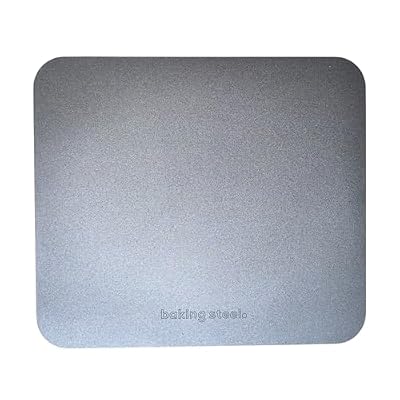
Original Baking Steel
6.4 mm is the home compromise: enough stored heat to bake two pies back to back, in a slab that will never crack the way a cordierite stone eventually does.
Check price on Amazon →Full review →Upgrade

ThermiChef 16 x 16 in Pizza Steel, 3/8 in
9.5 mm against the top pick's 6.4 mm, and 12.5 kg to lift with both hands. Worth the longer preheat only if you bake in runs — otherwise the extra mass sits there doing nothing.
Check price on Amazon →Budget pick

Doppio Living Lightweight Pizza Steel
3 mm and 3.2 kg against the top pick's 6.4 mm: ready soonest and out soonest, because less mass takes less time to saturate and holds less back once a base has drawn on it.
Check price on Amazon →Also considered

Made In Carbon Steel Pizza Steel
The outlier: round rather than rectangular, and perforated so oven air reaches the base through the plate — at 2 mm it also stores the least heat of the four.
Check price on Amazon →
How we chose
Start with the specification, because in this category all four makers publish one. Baking Steel publishes the top plate's thickness, weight, footprint and material. ThermiChef publishes 40.6 × 40.6 cm (16 × 16 in) at 9.5 mm (3/8 in) and 12.5 kg (27.5 lb) of low-carbon steel made in the USA. Doppio Living publishes 40.6 × 34.3 cm (16 × 13.5 in) at 3 mm (0.12 in) and roughly 3.2 kg (7 lb) of flaxseed-seasoned A36, also made in the USA. And Made In publishes the fullest sheet of the four — 32 cm (12.6 in) across, 2 mm thick, 1.2 kg (2.6 lb), 86 perforations, made in Sweden. So every thickness, footprint and mass quoted above is a manufacturer's own figure rather than a listing's paraphrase of one, which is rarer in this category than it ought to be; where a maker prints nothing, this page says nothing. The conductivity figures belong to the materials rather than to any product. On top of that sits this site's dough canon: a home oven caps out at 250–290 °C, leoparding needs 400 °C and above, and a base either sets in the first seconds or it does not set at all. We own no test kitchen and run no product trials, so nothing here is ranked by first-hand use. Where two plates match on material and thickness, what remains is price and how easily you can get one, and that is how the tie breaks.
If this goes wrong
If the underside comes out pale and floppy, suspect the preheat before the purchase — a plate that has not saturated has nothing to give, and it will underperform a stone that has. Check the same thing first when the base stays soggy in the middle: the water in the dough leaves fastest where the heat arrives fastest.
The opposite failure has the opposite cause. A burnt base under undercooked toppings means the conduction is working and the radiant heat above it is not, which is a rack and grill problem rather than a reason to buy something else.
And if the deck never gets there at all, read an oven that will not get hot enough before you spend anything: a thermostat that undershoots by 40 °C defeats any surface you put in it. If you are coming from ceramic, one failure does not carry over — a pizza stuck to the stone is a porous, under-floured surface, and swapping the material changes the surface it happens on rather than the habit that causes it.
Who should skip this
- You are saving for an outdoor oven anyway — put the money there, because more heat beats faster heat and nothing here closes that gap.
- You will not preheat before every bake — 45 to 60 minutes at full temperature for a thick plate, and a real wait even for a thin one. Cold, any of them is worse than a bare tray.
- You bake pan, Detroit and Sicilian styles only: the oiled tin is already the conducting surface, and it comes up to heat with the dough in it.