
Home oven won't get hot enough for pizza
By ThePizzaPlanet.com · Updated
The short answer
A domestic oven tops out at 250–290 °C (480–555 °F) and no trick moves that ceiling. Load it with a steel, preheat 45–60 minutes, finish under the grill, and aim at New York rather than Neapolitan — a style built for the heat you actually have.
Skip to the fix ↓Top pick
What you're seeing
Every recipe you read talks about 450 °C and a 90-second bake, and your oven dial stops at 250 °C. You turned it up as far as it goes and the pizza still sat there the best part of ten minutes before anything happened. What comes out is edible but slack — no real crisp underneath, a rim that browned rather than puffed. And the second pizza is always worse than the first, which tells you the oven never had much heat in reserve.
The short answer
The ceiling is real. A domestic oven produces 250–290 °C (480–555 °F) and nothing you do will change that number, so stop trying to and start working the two variables you still control: how much heat is stored in the oven when the pizza lands, and how fast that heat crosses into the dough. A steel preheated for a full hour, the grill element brought into the bake, and a recipe designed for a longer, cooler bake will get you a very good pizza. It will not get you a Neapolitan one.
Why it happens
The air in your oven barely holds any heat at all
The temperature on the dial describes the air in the cavity, and air is a terrible reservoir. A 60-litre oven at 250 °C contains about 40 grams of air, which stores roughly 40 joules for every degree it cools. A 36 cm square of 6 mm steel weighs around 6 kg and stores close to 3,000 joules per degree — some seventy times more.
Open the door and the air dumps out within seconds; the slab does not care. When the pizza lands, the energy driving water out of the base comes almost entirely from the slab. Your oven's real capacity is whatever mass you heated first.
The slab needs an hour, and the beep is not the finish line
The thermostat measures air, so it beeps when the air reaches temperature — typically 15–20 minutes in. A stone or steel is still tens of degrees behind and keeps climbing for another 45–60 minutes. Launch onto a slab 60 °C short and the first ninety seconds, the window in which a base either dries or does not, are spent warming the plate.
Material decides how that stored heat comes back out. Carbon steel conducts at roughly 45 W/m·K against cordierite's 2.5 — about 18 times faster — so a baking steel at 250 °C drives energy into the dough far harder in those first seconds than a stone at the same temperature. When temperature is capped, conduction is the one lever left.
The thermostat is swinging while you bake
Domestic ovens hold temperature by cycling the element on and off, and the swing is commonly ±10–15 °C around the set point. Launch at the bottom of a cycle and the cavity is at 235 °C rather than 250 °C for the first minutes of the bake. Running the grill for the last stretch of preheat pushes the roof and the top of the slab past where the thermostat would settle, and puts radiant heat over the toppings so the top keeps pace.
You are aiming at the wrong style
Neapolitan dough is flour, water, salt and yeast, and works because 60–90 seconds at 430–480 °C (800–900 °F) sets the crumb before it can dry. Give it eight minutes at 250 °C and you get a dry, even-brown rim and no leopard-spotting — the mechanism was never available to you. New York dough carries 2–3% oil and 1–2% sugar and sits lower in hydration precisely because it is built for a longer, cooler bake — the sugar gives the surface something to brown with where plain starch will not, and the oil keeps the crumb tender over six or seven minutes.
Fix it now
- Oven to maximum, slab on the upper-middle rack. Not the bottom — the toppings need to be near the roof, where the radiant heat is.
- Preheat 45–60 minutes, timed from the beep, not from when you turned it on. The highest-value step here, and the one most often shortened.
- Run the grill element for the last 10 minutes of the preheat. It loads the oven roof and the top of the slab well above the thermostat's settling point.
- Check the slab, not the dial — and aim at the right bit of it. Point an IR gun at a dark, seasoned patch in the middle of the steel, never at bare polished metal: shiny steel reflects infrared rather than emitting it, and a gun with its emissivity fixed at 0.95 can read tens of degrees low on it. Cordierite stone, being matte, reads honestly. Use the same spot every time for a trustworthy trend. Below about 240 °C (465 °F) it is not ready, whatever the oven says.
- Launch fast and shut the door. Every second open costs the cavity's air and cools the roof.
- Bake 6–8 minutes and judge by the underside. Lift an edge and look; melting cheese is not the signal to pull it.
- Rest 20 minutes between pizzas. The first pizza takes real energy out of the slab, and the second one bakes on a cool plate unless you let it reload.
Prevent it next time
- Pick a dough that suits 250 °C. A malted bread flour around 12.7% protein with 2–3% oil and 1–2% sugar browns at home temperatures where 00 stays pale and floppy. Set the ratios with the New York calculator.
- Come down slightly on hydration. 60–63% dries at the surface sooner than 68% does, and reaching that stage sooner is the whole game in a slow oven.
- Leave the slab in the oven permanently. It evens out everyday baking and removes the temptation to skip the preheat.
- Keep the load light. Extra sauce and cheese means extra water to boil off, and boiling water holds the base at 100 °C — which is how a slow oven ends up with a soggy centre.
- Do not chase the self-clean cycle. Hot, but locked, forbidden by most manufacturers, and a good way to destroy an oven.
- Judge against the right target. A well-browned, crisp New York slice out of a domestic oven is a success. Measuring it against a Naples photograph is not a fair fight.
- Decide once whether the ceiling is worth buying past. Our honest guide to pizza ovens for home bakers covers what 400 °C actually changes and who should not bother.
What you might need
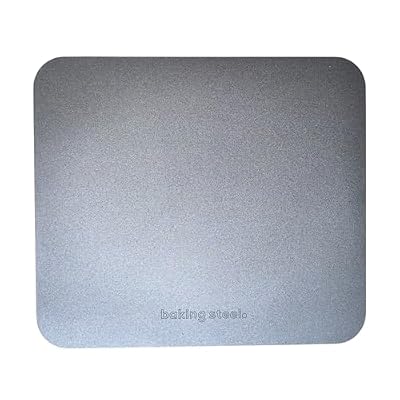
Original Baking Steel
When you cannot raise the temperature, the only lever left is how fast the heat you have moves into the dough — steel conducts about 18× faster than cordierite (~45 W/m·K against ~2.5) and stores far more energy than the air ever will.
Read our full review →
Etekcity Lasergrip 1080 Infrared Thermometer
Your dial reports air, and the air is not what cooks the base. An IR gun tells you the slab is at 255 °C rather than 200 °C, which is the difference between a preheat that is finished and one that only sounds finished — aim it at a dark, seasoned patch, because bright steel reflects infrared and reads low.
Read our full review →Put it into practice
Quick questions
How hot should a home oven be for pizza?
As hot as it goes, with no exceptions worth making. Set it to maximum — usually 250 °C (480 °F), sometimes 275–290 °C (525–555 °F) — and preheat a steel or stone for 45–60 minutes after the oven signals it has reached temperature. Every degree below the ceiling costs you time in the oven, and time in the oven is what dries a pizza out.
Can you make Neapolitan pizza in a home oven?
You can make a very good pizza, but not a Neapolitan one. The style is defined by a 60–90 second bake at 430–480 °C (800–900 °F), which is roughly 200 °C above what a domestic oven can produce. At 250 °C the same dough needs 6–8 minutes, and in those extra minutes the crumb dries out instead of staying soft. New York style — slightly lower hydration, a little oil and sugar, a longer bake — was developed in deck ovens running 290–320 °C (555–610 °F) and travels down to home temperatures far better.
Should I use the self-clean cycle to get my oven hotter?
No. The pyrolytic cycle does run at 450–500 °C (840–930 °F), but it locks the door for the duration, and defeating that lock is how people blow thermal fuses, crack door glass, and void warranties. Most manufacturers explicitly forbid it. A steel on the top rack with the grill running gets you a genuinely good pizza without any of that risk.
Related problems
Get the right measurements
Most dough problems start with bad ratios. Use our calculator for exact measurements.