
Pizza base is soggy in the middle
By ThePizzaPlanet.com · Updated
The short answer
Not enough heat is reaching the centre of the base fast enough to drive the water out before the crust sets. Bake on a fully preheated steel or stone rather than a tray, give it 45–60 minutes at maximum, and cut the water you put on top.
Skip to the fix ↓Top pick
What you're seeing
The cornicione came out well — puffed, browned, crisp where you expected it. Then you lift the first slice and the tip folds straight over and drips. The centre of the base is pale, damp and slightly gummy, and where you have cut through you can see that the sauce has soaked down into the dough rather than sitting on top of it. Sometimes the whole middle lifts away from the toppings as a wet sheet. The edges are fine; only the middle failed, and it failed on the underside.
The short answer
The base is not getting heat fast enough to boil the water out before the crust sets. Bake directly on a fully preheated steel or stone — not a tray, and not a slab that has only had 20 minutes — and cut the amount of water you are loading on top. Those two changes fix the overwhelming majority of soggy centres.
Why it happens
The base cannot crisp until the water is gone
Dough that is still wet is stuck at 100 °C (212 °F). All the energy going into it is being spent turning water into steam, and nothing is left over to raise the surface temperature into the range where starch sets and browning starts. Crisping is what happens after the drying.
Where that water goes is the whole story. At the rim, steam escapes sideways into open air. In the centre it is trapped between a slab underneath and a sealed layer of cheese above, so its only route out is downwards through the dough — meaning the centre needs the most heat from below and usually gets the least. That is why the failure is a ring in the middle rather than an even sogginess.
Trays and cold stones do not deliver heat
A baking tray is thin, low-mass and often warped, so it touches the dough in patches and has almost no stored energy to give; twenty seconds after the pizza lands its surface temperature has crashed. A stone or a steel works because it is a heat battery, holding a large amount of energy and dumping it into the base in the first 60–90 seconds.
The two are not equal. Carbon steel conducts at roughly 45 W/m·K against cordierite's 2.5 — about 18 times faster — so a baking steel delivers its stored heat into the dough far more aggressively than a stone of the same temperature. In a home oven capped at 250–290 °C (480–555 °F), that conduction advantage is the single biggest lever you have on the underside of a pizza.
Preheat is the other half, and it is where most soggy bases are made. The thermostat reports air temperature, which arrives in 15 minutes; a 6 mm steel or a 15 mm stone takes 45–60 minutes after that to saturate. Launch onto a slab 80 °C below the air around it and you have effectively baked on a warm tray.
You loaded more water than the bake can evaporate
A 6-minute bake can only shift so much moisture, and some of the water arrives before you have done anything: a tin packed in thin juice gives a sauce that is already loose when you crush it, where one packed in puree starts near the consistency you were aiming for — the tinned tomato guide explains which is which. Sauce is around 90% water; fresh mozzarella can be 50–60% water and releases most of it in the first two minutes; mushrooms, courgette, fresh tomato and thawed vegetables all bleed onto the dough. Pile three of those together and the centre spends its whole bake underwater.
A thinly dressed pizza is not an aesthetic choice — it is the arithmetic of a short bake. Around 80–100 g of sauce and 100–120 g of cheese on a 30 cm base is a load the oven can dry out, which is why a simple New York cheese slice comes out crisp when a loaded one does not.
The centre was pressed too thin
Counter-intuitively, an over-thinned middle makes sogginess worse. A base stretched almost to translucency has no structure left to hold sauce off the dough, so liquid soaks straight in and the layer becomes one wet composite that cannot dry from either side. Aim for a centre that is thin and even, around 3 mm.
Fix it now
- Preheat properly, starting now. Slab on the upper-middle rack, oven to maximum, 45–60 minutes on the clock after it beeps. Allow 5–8 minutes of recovery between pizzas.
- Bake on steel or stone, never on the tray. If you own neither tonight, preheat a heavy cast-iron pan for 45 minutes and use that — mass beats no mass.
- Cut the sauce back and drain the wet toppings. 80–100 g of sauce on a 30 cm pizza, to within 2 cm of the edge. Pat fresh mozzarella dry and tear rather than slice it, and pre-cook anything that weeps.
- Dress fast and launch fast. Every extra 30 seconds on the peel is more moisture soaking into the underside — 45 seconds from sauce to launch is a good target.
- Give the middle a moment at the end. If the rim is done and the centre is still pale, slide the pizza back onto the slab for a final 30–45 seconds.
- Rest it 2 minutes on a rack, not a board. A board traps escaping steam and re-softens the crust you just made.
- If the centre is properly raw rather than damp, the problem is heat, not water — that is a pale, under-baked base, and it needs a hotter slab and a longer bake.
Prevent it next time
- Preheat 45–60 minutes, every time. It is the cheapest fix on this page and the one most often skipped.
- Use the top half of the oven. Closer to the roof means more radiant heat on the toppings, so you can bake hotter and shorter without burning the base.
- Weigh your sauce and cheese once. Once you know what 90 g of sauce looks like on a base, you never need the scale again.
- Build the dough for the oven you own. A 12.7% bread flour at 62–65% hydration takes a longer, lower home-oven bake far better than a soft 00 does — the New York settings are aimed at exactly this.
- Keep the base an even 3 mm, pressing from the centre outwards and stopping before you can see through it.
- Cook one pizza at a time, and slide each onto a wire rack. Two pizzas halve the heat available to each and double the moisture in the cavity; two minutes of venting keeps a crisp base crisp all the way to the plate.
What you might need
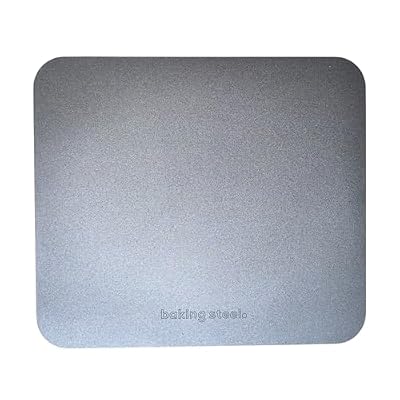
Original Baking Steel
Steel conducts heat about 18× faster than cordierite stone (~45 W/m·K against ~2.5), which is exactly the difference between a base that dries out in the first 90 seconds and one that steams.
Read our full review →
Skyflame Aluminium Pizza Peel (14 × 16 in)
A soggy centre is often a slow launch; a rigid peel with a thin leading edge gets a dressed pizza onto hot steel in one motion instead of three.
Read our full review →Put it into practice
Quick questions
Why is only the middle of my pizza soggy?
The centre is the last place moisture can escape from. Steam from the sauce and the dough vents easily at the open edge, but in the middle it has to go down through the base or up through a sealed layer of cheese. Until that water has boiled off, the dough underneath cannot rise above 100 °C (212 °F) and cannot crisp.
How long should I preheat a pizza stone or steel?
45–60 minutes at your oven's maximum, and start timing when the oven reaches temperature, not when you switch it on. The oven thermostat measures air; the slab lags far behind it, and a stone that has had 20 minutes is often 60–80 °C cooler than the air around it.
Does less sauce really fix a soggy base?
It helps a great deal. Sauce is mostly water, and every gram of it has to be boiled off with heat that would otherwise be crisping the dough. For a 30 cm pizza, 80–100 g of sauce spread thin is plenty; double that and you are asking the oven to evaporate an extra 100 g of water in the same 6 minutes.
Related problems
Get the right measurements
Most dough problems start with bad ratios. Use our calculator for exact measurements.