
Pizza stuck to the stone
By ThePizzaPlanet.com · Updated
The short answer
An under-heated stone lets wet dough soak into its pores instead of setting on contact. Preheat 45–60 minutes at maximum, patch any tear before you launch, and clean the stone by scraping and burning residue off — never with soap or water.
Skip to the fix ↓Top pick
What you're seeing
The launch went perfectly. Then, when the pizza is done and you slide the peel under it, the base tears — a disc of dough stays behind on the stone, welded flat, while the rest of the pizza comes away in pieces. Sometimes there is a black ring of baked sauce around the stuck patch where liquid found a hole and ran through. The dough left behind is usually pale and slightly damp on its underside, not charred, which is the clue that matters: it never finished cooking where it was stuck.
The short answer
The stone was not hot enough to set the base on contact, so the dough sat in its pores and baked into them. Preheat for a full 45–60 minutes at your oven's maximum, check the base for thin spots and tears before you launch, and clean the stone by scraping and heat rather than soap and water. A properly hot slab releases a pizza almost by itself.
Why it happens
A hot surface sets the base before it can bond
When dough meets a slab at 250 °C (480 °F) or above, the bottom half-millimetre dries and its starch gelatinises within a couple of seconds. That thin, set layer is what a finished pizza rides on — it is rigid, it is dry, and it does not adhere to anything.
Give the dough a cooler surface and none of that happens fast enough. The base stays wet and pliable while it is in contact, and wet dough behaves like paste: it flows into the surface texture beneath it and then hardens there. On a cordierite stone the texture in question is a network of open pores, which is why a stone grips harder than a smooth metal plate. That is also why the stuck patch always looks under-baked — it is under-baked, and being under-baked is precisely why it stuck.
Preheat is where this is won or lost. The thermostat measures air, which arrives in 15 minutes; a 15 mm stone needs 45–60 minutes after that to saturate through. A stone that has had half an hour can be 60–80 °C behind the air around it — more than enough to turn a clean release into a welded one, and the same shortfall that produces a soggy centre.
Material decides how forgiving the surface is
Cordierite and clay are porous by design; that porosity is what lets a stone absorb a little moisture from the dough. It also means a stone drinks oil, soap, sauce and anything else it meets, and never fully gives it back. Steel is the opposite: non-porous, smooth, and over time it develops a thin polymerised film from the oils it encounters, exactly like a seasoned cast-iron pan. Add its far higher conductivity — carbon steel is around 45 W/m·K against cordierite's 2.5, roughly 18 times faster — and a baking steel sets the base so quickly that sticking becomes rare rather than routine.
Sauce and cheese weld harder than dough does
Dough on a stone is annoying; sugar and protein on a stone is a repair job. Sauce that escapes through a tear, or cheese that runs off the edge, caramelises directly onto the surface and forms a hard, dark deposit. The next pizza then sticks to that rather than to the stone. This is the case for restraint on a rich pie — a quattro formaggi carries a lot of fat that will happily run over the edge if the cheese goes right to the rim.
A tear in the base does the rest
A hole in the middle of the disc is an open channel from the sauce to the stone. Even a thin, translucent patch that has not quite torn will let liquid through in the first 30 seconds of the bake. A dough that reached the peel already fragile is often the same dough that stuck to the peel on the way in.
Fix it now
- Get the pizza off with a bench scraper, not the peel. Work the flat blade in under one edge of the stuck disc and push straight along the stone. Prying upwards shreds it.
- Leave the residue alone until the stone is cold. Scraping a hot stone can gouge it, and any liquid you introduce now risks cracking it outright.
- Scrape cold, then burn the rest off. A stiff plastic or metal scraper takes the bulk; run the oven at maximum for 45 minutes, or through a self-clean cycle if it has one, to carbonise what is left. Brush the ash away.
- No soap, no soaking, ever. Cordierite absorbs detergent and releases it back into the next few bakes as a soapy aftertaste. Stains are cosmetic — a well-used stone is meant to look dark and blotchy.
- Before the next launch, hold the base up to the light. Any window you can see through gets pinched closed or patched with a scrap of dough from the rim.
- Preheat properly and check. 45–60 minutes at maximum, timed from when the oven reaches temperature, and read the surface with an infrared thermometer before you commit a pizza to it.
- Keep the sauce and cheese inside a 2 cm border, so nothing has a route over the edge onto the stone.
Prevent it next time
- Treat 45–60 minutes of preheat as part of the recipe. Most sticking is just impatience with a thermal mass.
- Bake on steel if sticking is a recurring problem. Non-porous, seasoned and fast — it removes the mechanism rather than managing it.
- Dust with coarse semolina, thinly. It gives the base something to ride on for the first seconds; a thick layer just burns and tastes bitter.
- Match the flour to the bake. A W260–280 00 such as Caputo Pizzeria is built for 8–24 hours and a very hot, very short bake — the conditions in which a base sets on contact instead of soaking in. The Neapolitan settings give you the hydration and dose to go with it.
- Do not stretch the centre to translucency. An even 3 mm base has no channel for sauce to escape through.
- Scrape the stone between pizzas. Ten seconds with a scraper stops one spill becoming three stuck pizzas.
- Store the stone in the oven. It stays dry, evens out your oven's heat for everything else, and never gets washed by accident.
What you might need
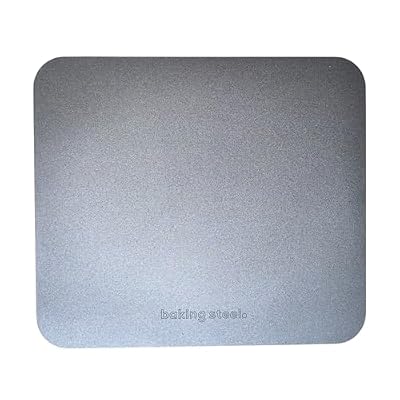
Original Baking Steel
Steel is non-porous and takes a seasoned, polymerised oil surface, so dough releases from it far more reliably than from an absorbent cordierite stone — and its ~45 W/m·K conductivity sets the base within seconds.
Read our full review →Put it into practice
Quick questions
Why does pizza stick to a pizza stone?
Nearly always because the stone was not hot enough. A stone at full temperature sets the surface of the dough within a few seconds, and a set base does not bond. A stone that has only had 20 minutes is still cool and porous, so wet dough soaks into it and bakes in place.
How do you clean a pizza stone?
Let it cool completely, scrape the residue off with a bench scraper or a stiff plastic blade, and burn the rest away by running the oven at maximum for 45 minutes or through a self-clean cycle. Never use soap — cordierite is porous and will absorb it, then release it into the next few pizzas. Never put water on a hot stone either; the thermal shock cracks it.
Do baking steels stick like stones do?
Much less. Steel is non-porous, so there is nothing for dough to soak into, and repeated use builds a thin polymerised oil layer that behaves like the seasoning on a cast-iron pan. Steel also transfers heat about 18× faster than cordierite, so the base sets almost on contact.
Related problems
Get the right measurements
Most dough problems start with bad ratios. Use our calculator for exact measurements.