
Japanese mentaiko pizza
Mentaiko pizza, documented from two Japanese chains — Pizza California and Pizza-La — rather than invented: spicy pollock roe bound into a potato-and-mayonnaise filling, with mochi and chicken thigh as the one real difference between them, on a cold-fermented New York crust.
Recipe by ThePizzaPlanet.com · Published
Essential tool for this bake
Mentaiko pizza is not this site's invention — it is a standing menu item at two separate Japanese pizza chains, and this recipe documents what those chains actually sell rather than guessing at a "Japanese pizza" from imagination. The crust underneath it is unrelated to the topping's origin: a straight King Arthur Bread Flour New York build at 12.7% protein, cold-fermented for a full day the way any New York dough is, because a fusion topping does not change what the dough needs to do. If the base turns soggy under a wet filling, a soggy middle covers the fix; if the crust bakes unevenly, see pizza cooking unevenly; if it tears getting off the peel, see pizza stuck to the peel.
Where this comes from
Two companies sell a named mentaiko pizza in Japan — the two-chain floor this site requires to call something a documented style rather than an invented one, the same bar every recipe in the fusion collection has to clear, and the thinnest margin of the three Japanese fusion recipes here — one of three styles gathered at the Japan hub alongside teriyaki chicken and seafood pizza.
Pizza California sells チキン明太マヨネーズ (Chicken Mentaiko Mayonnaise) at pizza-cali.net, and its product page prints the fullest ingredient record in this entire branch of research: 明太フィリング(明太子、ポテト、オニオン、マヨネーズ)、鶏もも肉、マヨネーズ、パセリ — a mentaiko filling of roe, potato, onion and mayonnaise, plus chicken thigh, mayonnaise and parsley. Reading that ingredient order — filling first, no separate base sauce named anywhere on the page — suggests a sauce-free, filling-based pizza. That is a reading of the printed order, not a statement the page makes outright, and it is presented here as exactly that: an inference, not a printed fact.
Pizza-La sells もち明太子ピザ (Mochi Mentaiko Pizza) at pizza-la.co.jp, but its standing menu page states a name and a price only — no ingredients at all. The per-item "詳細" (detail) link that would normally carry a topping list instead redirects to a member login page. What this recipe can attribute to Pizza-La comes from a different kind of source: a time-limited campaign page, not the transactional menu itself, which states 本場博多の明太子を使用した特製明太ソースで和えたほくほくポテトとおもちが相性抜群 — fluffy potato and mochi tossed in a special mentai sauce made with authentic Hakata mentaiko. That line is worth quoting, but it is marketing copy with an expiration date, not the standing product record Pizza California prints — the same limitation the site's teriyaki chicken recipe hits with Pizza-La's own campaign page.
The one real difference between the two chains: mochi appears only at Pizza-La's campaign description, and chicken thigh appears only at Pizza California's menu page. Neither ingredient is a shared claim, and this recipe treats both as optional add-ons to the mentai filling both chains do agree on, rather than folding either into a single combined "authentic" version neither chain actually sells.
What makes it that style
One decision defines this pizza, grounded in what both chains' own pages state: mentaiko is built into a filling with potato and mayonnaise, rather than scattered loose across the pizza as roe. Mentaiko is salty, delicate roe packed in a thin membrane sac — under direct oven heat for eight to ten minutes it dries out, discolors and turns grainy if it goes on raw and whole. Binding a portion of it into a potato-and-mayonnaise base spreads the flavor evenly and gives the roe something to sit in rather than exposed heat to sit under, which is exactly the composition both Pizza California's stated ingredient line and Pizza-La's campaign description agree on.
Neither chain's own page evidences a tomato base for this style: Pizza California's ingredient order reads as sauce-free, as noted above, and Pizza-La's campaign page names a mentai sauce built from Hakata mentaiko, not a tomato one. This recipe uses a thin tomato sauce base under the filling anyway — this site's standard New York crust convention, and a practical need neither chain's page addresses: a heavy potato-and-mayonnaise filling needs something between it and bare dough, or the base underneath it never sets. That is a departure from what either chain's page actually describes, made deliberately and stated here rather than left to look like it came from a menu.
Reserving a second portion of raw mentaiko to scatter on after the bake is a technique decision made for this recipe specifically, not an instruction printed by either chain — neither source describes a two-stage application. It exists because the same fragility that argues for binding most of the roe into a cooked filling argues against baking all of it: a portion held back and added once the pizza is off the heat keeps its native colour and soft texture, rather than every last gram of roe going through the oven.
Mochi is the optional second texture, and it belongs to Pizza-La alone — Pizza California's own page never mentions it. Chicken thigh runs the other way: it is named on Pizza California's page and nowhere in what Pizza-La states. Domino's Japan does not currently list any 明太子 product — its menu catalogue was searched directly for the term and returned no hits — so this recipe rests on two chains, not a third confirming one.
If the filling's moisture pools in the center rather than crisping at the edge, a soggy middle is the fix to check before blaming the potato.
Flour: King Arthur Bread Flour (12.7% protein) — read the review
Dough Formula
| Ingredient | Grams | Baker's % |
|---|---|---|
| Flour (12.7% protein) | 996 g | 100.0% |
| Water | 627 g | 63.0% |
| Salt | 19.9 g | 2.0% |
| Yeast | 5 g | 0.5% |
| Oil | 30 g | 3.0% |
| Sugar | 10 g | 1.0% |
Makes 4 balls of ≈422 g
Ingredients
Dough
- Pizza dough (see formula above)4 balls
Mentai filling
- Mentaiko — Sold in paired sacs; slit the membrane lengthwise and scrape the roe out rather than chopping the sac240 g
- Cooked potato — Peeled, boiled or steamed until tender, then diced small400 g
- Onion — Finely diced120 g
- Japanese-style mayonnaise150 g
Tomato sauce base
- Crushed tomatoes400 g
- Garlic — Minced2 cloves
- Saltpinch
- Olive oil14 g
Chicken (Pizza California)
- Chicken thigh, boneless — Cut into bite-sized pieces400 g
Toppings
- Low-moisture mozzarella — Shredded300 g
- Mochi — Cut into thin slices; optional, and attributed to Pizza-La alone — leave it out and this is Pizza California's version200 g
- Parsley — Finely chopped, for finishinghandful
Instructions
- 1
Whisk the yeast into the flour. Add water at 30-32°C (86-90°F), the oil and the sugar, and stir with a spatula until no dry flour remains.
- 2
Sprinkle the salt over the top and knead 10-12 minutes, by hand or machine, until smooth and elastic.
💡 This dough sits unshaped for a day before it sees an oven, so develop the gluten fully now — a slack dough here stays slack after 24 hours in the fridge.
- 3
Cover the bowl and let the whole piece bulk ferment at room temperature for about 1 hour, until slightly puffy. Leave it as one mass — it is not divided into balls yet.
- 4
Transfer the dough, still in one piece, to a lightly oiled, tightly covered container and refrigerate for 24 hours.
💡 This is the ferment the calculator's New York schedule is built on — the 27 h 40 min this page states is prep and cook time plus that schedule, not a rounding artifact. Skipping or shortening it leaves a dough that behaves like a same-day pan crust, not a New York one.
- 5
Make the mentai filling: slit each mentaiko sac lengthwise with a knife and scrape the roe out with the back of the blade rather than chopping the sac, discarding the membranes. Set two-thirds of the scraped roe aside, covered, in the fridge.
💡 Reserving a portion of raw roe for after the bake is a technique decision made for this recipe, not an instruction printed by either chain — mentaiko cooked through the full bake turns grey-brown and grainy, so holding some back protects its colour and soft texture.
- 6
Combine the remaining one-third of the roe with the diced potato, onion and mayonnaise. Stir until the potato is evenly coated — this is the filling that goes on before the bake.
💡 Neither chain's page states a filling-to-mayo ratio; this is a derived proportion built to spread and bind, not something scraped from a menu.
- 7
Take the dough out of the fridge — it should look puffy and have expanded significantly — and divide it into 4 balls of 422 g each, tucking the edges under to build surface tension.
- 8
Cover the balls loosely and let them come fully to room temperature, about 90 minutes, until relaxed and easy to stretch — they will still feel cool at the center but should no longer resist a light press.
💡 Stretching cold dough tears instead of extending. If a ball keeps springing back, give it another 15-20 minutes rather than forcing it.
- 9
Heat the oven to 260-290°C (500-555°F) with a baking steel on the highest usable rack for 45-60 minutes.
- 10
If making the chicken version, sear the chicken thigh in a hot, lightly oiled pan for 6-8 minutes, turning occasionally, until browned and cooked through.
- 11
Stretch one ball to about 36 cm. Spread a thin layer of the tomato sauce base, leaving a bare rim, then scatter the mozzarella. Top with a quarter of the mentai filling, a quarter of the chicken (if using) and, if adding mochi, a few slices scattered over the top.
- 12
Slide onto the steel and bake 8-10 minutes, until the cheese is deep brown at the rim, any mochi has puffed and softened, and the base lifts with a stiff, crackling edge.
- 13
Slide onto a rack and immediately scatter a portion of the reserved raw mentaiko roe over the hot surface, along with a scattering of parsley. Rest 2-3 minutes, then slice. Repeat for the remaining three balls.
Tips
- →The dough goes into the fridge as one undivided mass and gets balled after the cold ferment, not before — matching the site's calculator schedule for New York, not a same-day pan sequence.
- →Mentaiko is sold in sacs, not loose roe — slit and scrape rather than chop, or the membrane ends up in the filling.
- →Mochi is Pizza-La's addition alone; Pizza California's version carries chicken thigh instead. Making both at once is not documenting either chain, so pick one.
Video by Jenny Dang · 1.4K views · 9 min · CC · on YouTube
Shop this bake
Flour

King Arthur Bread Flour
The first bag to buy if you bake in a domestic oven. At 12.7% protein with added amylase on the label it gives you chew and colour at 250 °C, which is exactly what an unmalted 00 will not.
$15.84· as of Oct 11, 2026, 16:49 UTCCheck price on Amazon →Read the review →i
Product prices and availability are accurate as of the date/time indicated and are subject to change. Any price and availability information displayed on Amazon.com at the time of purchase will apply to the purchase of this product.Ingredient

Cento All Purpose Crushed Tomatoes
Crushed in the tin instead of by hand, and sold as one can rather than a case — the low-commitment way in when a six-tin case is what stops you buying at all.
Check price on Amazon →Read the buying guide →Ingredient

Polly-O Low Moisture Whole Milk Mozzarella
Thick enough to cube for a Detroit rim, where shreds burn to lace — and four ingredients against a coating of rice flour, cellulose and natamycin that no bake removes.
$39.00· as of Oct 11, 2026, 16:49 UTCCheck price on Amazon →Read the review →i
Product prices and availability are accurate as of the date/time indicated and are subject to change. Any price and availability information displayed on Amazon.com at the time of purchase will apply to the purchase of this product.Ingredient

SAF Instant Yeast
Instant, so it goes in dry with the flour: no warm-water step means no step at which the yeast can be cooked, which is where an active-dry dough most often dies.
Check price on Amazon →Read the review →Equipment
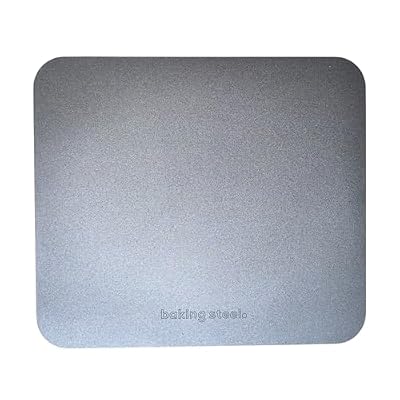
Original Baking Steel
6.4 mm is the home compromise: enough stored heat to bake two pies back to back, in a slab that will never crack the way a cordierite stone eventually does.
$139.00· as of Oct 11, 2026, 16:49 UTCCheck price on Amazon →Read the review →i
Product prices and availability are accurate as of the date/time indicated and are subject to change. Any price and availability information displayed on Amazon.com at the time of purchase will apply to the purchase of this product.Equipment

Greater Goods Single Sensor Baking Scale
One model behind one listing, on the maker's own page: 5 kg (11 lb) of capacity, reading down to 1 g. What the listing sends is what the maker documents — rarer here than it ought to be.
Check price on Amazon →Read the buying guide →
If this goes wrong
Pizza base is soggy in the middle
Not enough heat is reaching the centre of the base fast enough to drive the water out before the crust sets. Bake on a fully preheated steel or stone rather than a tray, give it 45–60 minutes at maximum, and cut the water you put on top.
Pizza cooks unevenly (one side burns)
No oven heats evenly across its floor, and the pizza does not move on its own. Find your hot spot, centre the slab with a gap all round for air to circulate, and turn the pizza 180° at roughly 60% of the bake.
Pizza stuck to the peel
Moisture from the dough has turned your bench flour into glue, and time is what let it happen. Launch within 60 seconds onto a bed of coarse semolina, shake the peel every 20 seconds while you dress, and free a stuck pizza with a bench scraper before you try again.
More New York Recipes
Try another recipe
We have 33 recipes across 7 pizza styles. Something didn't work? Check our troubleshooting guide.