
Brazilian calabresa pizza
Calabresa pizza, documented from two Brazilian chains that agree on sliced calabresa sausage over mozzarella and state no sauce at all — onion and green olives are Super Pizza Pan's addition alone — on a thin-stretched, cold-fermented New York crust.
Recipe by ThePizzaPlanet.com · Published
Essential tool for this bake
Calabresa is not a novelty here — it is Brazil's everyday pizza, and this recipe documents what those chains actually print rather than assuming a "Brazilian pizza" from imagination. The crust underneath sits on a straight King Arthur Bread Flour New York build at 12.7% protein, cold-fermented for a full day the way any New York dough is, stretched thinner than usual to suit — Brazilian chain pizza runs massa fina, a thin round crust, and New York is the closest of this site's seven styles to that without being an exact match. If the cheese browns before the base is cooked through, see cheese burning before the base cooks; if the base comes out pale and floppy, see a pale, floppy base; if the dough tears while stretching this thin, see dough tearing when stretching. This is one of three fusion recipes documenting Brazilian chain pizza, alongside portuguesa.
Where this comes from
Two distinct Brazilian chains, two different companies, each print a live product page naming calabresa as the topping. This is one of three Brazilian fusion styles gathered at the Brazil hub, alongside portuguesa and banana com canela.
Super Pizza Pan sells Calabresa at superpizzapan.com.br, a fully server-rendered product page. It states, in full: "Mussarela, calabresa Sadia, cebola e azeitonas verdes" — mozzarella, Sadia-brand calabresa sausage, onion and green olives.
Mister Pizza sells Calabresa at misterpizza.com.br, a server-rendered Next.js page. Its entire description is one line: "Calabresa fatiada e muçarela" — sliced calabresa and mozzarella.
The floor both pages agree on is sliced calabresa sausage over mozzarella. Onion and green olives belong to Super Pizza Pan alone — Mister Pizza's one-liner names nothing beyond the sausage and the cheese. Neither page mentions any sauce at all — no tomato, no other base, on either chain's own page. That is not something missing from the sourcing; it is what both pages state, and this recipe keeps it that way rather than quietly adding a sauce and writing it up as if the chains agreed on one.
Pizza Hut Brasil and Patroni both list "Calabresa" as a standing item in their own nutrition PDFs — Patroni names two regional variants, "Calabresa Carioca" and "Calabresa Paulista" — with portion weight and kcal figures, but neither page states an ingredient list. They corroborate that calabresa is a standing menu entry across more chains than just these two, and nothing further — they never source an ingredient here.
Calabresa itself is worth explaining, because the name misleads: it is a Brazilian cured, smoked pork sausage, sold under brand names like Sadia, and it is not the same product as Italian salame calabrese despite the similar-sounding name. It is closer in character to a mild smoked pork sausage than to a cured salami — that difference is why it renders fat under heat rather than staying firm the way a thin-sliced salami does.
What makes it that style
Sliced calabresa sausage over mozzarella, with nothing underneath but bare dough, is the whole documented style — both chains' pages agree on that much and neither states a sauce. This recipe stays sauceless, matching what the pages describe rather than adding a tomato layer as an unstated assumption. A light brush of olive oil on the dough before topping stands in for the sauce layer other New York builds on this site carry, so the crust does not bake completely bare, but it is not a stated ingredient on either chain's page — just this recipe's own practical step.
Calabresa renders a lot of fat, more than a typical pepperoni or salami topping, because it is a fresh-cured smoked sausage rather than a dry-cured one. Slicing it thin — about 3 mm — keeps individual pieces from staying raw-textured in the center during a short bake, and it is worth pre-rendering: warming the slices briefly in a dry pan before they go on the pizza lets some of that fat cook off and drain away instead of pooling on top of the cheese. That step is this recipe's own technique for handling a fatty sausage on a short home-oven bake — neither chain's page describes a rendering step, because a commercial pizza oven runs far hotter and faster than a home oven and does not need it the same way.
Onion and green olives are Super Pizza Pan's addition, not a shared claim. Scattering them over the same mozzarella-and-calabresa base gives the fuller of the two documented versions; leaving them off gives Mister Pizza's plainer one-line version instead. Neither is more "correct" than the other — they are two real, distinct products from two real chains, and the honest recipe offers both rather than picking one and presenting it as the only calabresa pizza.
Sourcing note: look for calabresa sausage at a Brazilian market, where it is typically sold under the name "linguiça calabresa." Where one is not on hand, a mild smoked pork sausage — Portuguese-style linguiça or a plain smoked kielbasa-style sausage — is an acceptable substitute in texture and fat content; it will not carry the exact same seasoning, and no chain documented here endorses any particular substitute. Whatever sausage is used, the fat-rendering guidance above still applies.
Flour: King Arthur Bread Flour (12.7% protein) — read the review
Dough Formula
| Ingredient | Grams | Baker's % |
|---|---|---|
| Flour (12.7% protein) | 996 g | 100.0% |
| Water | 627 g | 63.0% |
| Salt | 19.9 g | 2.0% |
| Yeast | 5 g | 0.5% |
| Oil | 30 g | 3.0% |
| Sugar | 10 g | 1.0% |
Makes 4 balls of ≈422 g
Ingredients
Dough
- Pizza dough (see formula above)4 balls
Calabresa and mozzarella — the floor both chains agree on
- Calabresa sausage — Cured, smoked pork sausage — not the same product as Italian salame calabrese; sliced thin, about 3 mm320 g
- Low-moisture mozzarella — Shredded320 g
- Olive oil — For brushing the bare dough — neither chain's page states a sauce, so this stands in for onedrizzle
Onion and green olives — Super Pizza Pan's addition alone
- Onion — Thinly sliced into rings; optional, leave off for Mister Pizza's plainer version160 g
- Green olives — Pitted, halved; optional, leave off for Mister Pizza's plainer version24 pieces
Instructions
- 1
Whisk the yeast into the flour. Add water at 30-32°C (86-90°F), the oil and the sugar, and stir with a spatula until no dry flour remains.
- 2
Sprinkle the salt over the top and knead 10-12 minutes, by hand or machine, until smooth and elastic.
💡 This dough sits unshaped for a day before it sees an oven, so develop the gluten fully now — a slack dough here stays slack after 24 hours in the fridge.
- 3
Cover the bowl and let the whole piece bulk ferment at room temperature for about 1 hour, until slightly puffy. Leave it as one mass — it is not divided into balls yet.
- 4
Transfer the dough, still in one piece, to a lightly oiled, tightly covered container and refrigerate for 24 hours.
💡 This is the ferment the calculator's New York schedule is built on — the 27 h 25 min this page states is prep and cook time plus that schedule, not a rounding artifact. Skipping or shortening it leaves a dough that behaves like a same-day pan crust, not a New York one.
- 5
While the dough is in the fridge, slice the calabresa thin — about 3 mm — and, if you want less fat pooling on the finished pizza, pre-render it: warm the slices in a dry pan over medium heat for 2-3 minutes, until some fat has rendered and the edges just start to color, then drain on paper towel and set aside.
💡 Pre-rendering is optional and is this recipe's own technique for handling a fatty sausage on a short bake — neither chain's page describes it. Sliced thin either way, calabresa renders a lot of fat under direct heat; a thicker cut leaves the topping greasy and slows the base from setting.
- 6
Take the dough out of the fridge — it should look puffy and have expanded significantly — and divide it into 4 balls of 422 g each, tucking the edges under to build surface tension.
- 7
Cover the balls loosely and let them come fully to room temperature, about 90 minutes, until relaxed and easy to stretch — they will still feel cool at the center but should no longer resist a light press.
💡 Stretching cold dough tears instead of extending. If a ball keeps springing back, give it another 15-20 minutes rather than forcing it.
- 8
Heat the oven to 260-290°C (500-555°F) with a baking steel on the highest usable rack for 45-60 minutes.
- 9
Stretch one ball thinner than a standard New York round, to about 38-40 cm — Brazilian chain pizza is *massa fina*, a noticeably thinner round than the crust this dough is normally stretched to on this site, so give it the extra pull to suit.
💡 New York is the closest of this site's seven styles to massa fina, not an exact match — thin, cracker-leaning New York, not a Neapolitan-style puff at the rim.
- 10
Brush the bare dough lightly with olive oil, leaving a rim clear. Neither chain's page names a sauce, so this pizza goes straight from dough to topping rather than carrying a tomato layer.
- 11
Scatter the mozzarella over the oiled dough, then the sliced (and, if pre-rendered, drained) calabresa — sliced sausage over mozzarella with no sauce beneath is the whole documented floor both chains agree on.
- 12
For the fuller Super Pizza Pan version, scatter the onion rings and green olive halves over the top as well. For the plainer Mister Pizza version, leave them off.
💡 Mister Pizza's own page states, in full, Calabresa fatiada e muçarela — sliced calabresa and mozzarella, nothing else. Super Pizza Pan's page adds cebola e azeitonas verdes (onion and green olives) to the same mozzarella-and-calabresa base.
- 13
Slide onto the steel and bake 8-10 minutes, watching the top rather than the clock — a fatty sausage over bare dough with no sauce layer to slow it down can brown hard before the base has fully set. Pull it as soon as the cheese is deep brown at the rim and the base lifts with a stiff, crackling edge.
💡 If the cheese is scorching before the underside browns, the steel likely was not hot enough going in — a fully preheated slab cooks the base fast enough to keep pace with the cheese and fat on top.
- 14
Slide onto a rack, rest 2-3 minutes, then slice. Repeat for the remaining three balls.
Tips
- →The dough goes into the fridge as one undivided mass and gets balled after the cold ferment, not before — matching the site's calculator schedule for New York, not a same-day pan sequence.
- →Calabresa and mozzarella are the floor both chains state. Onion and green olives are Super Pizza Pan's addition alone, not something Mister Pizza's page names — leave them off for the plainer of the two documented versions.
- →This pizza carries no sauce because neither chain's page states one. Brushing the dough with a little olive oil before topping is this recipe's own stand-in for a sauce layer, not a printed ingredient.
Video by Cozinhando com a Ly · 51K views · 10 min · on YouTube
Shop this bake
Flour

King Arthur Bread Flour
The first bag to buy if you bake in a domestic oven. At 12.7% protein with added amylase on the label it gives you chew and colour at 250 °C, which is exactly what an unmalted 00 will not.
Check price on Amazon →Read the review →Ingredient

Polly-O Low Moisture Whole Milk Mozzarella
Thick enough to cube for a Detroit rim, where shreds burn to lace — and four ingredients against a coating of rice flour, cellulose and natamycin that no bake removes.
Check price on Amazon →Read the review →Ingredient

SAF Instant Yeast
Instant, so it goes in dry with the flour: no warm-water step means no step at which the yeast can be cooked, which is where an active-dry dough most often dies.
Check price on Amazon →Read the review →Equipment
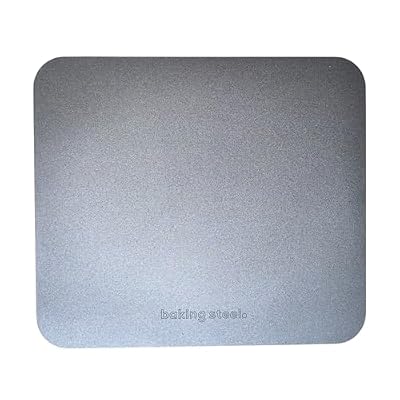
Original Baking Steel
6.4 mm is the home compromise: enough stored heat to bake two pies back to back, in a slab that will never crack the way a cordierite stone eventually does.
Check price on Amazon →Read the review →Equipment

Greater Goods Single Sensor Baking Scale
One model behind one listing, on the maker's own page: 5 kg (11 lb) of capacity, reading down to 1 g. What the listing sends is what the maker documents — rarer here than it ought to be.
Check price on Amazon →Read the buying guide →
If this goes wrong
Cheese burns before the base cooks
The top of your oven is running far ahead of the bottom. Get the slab hotter so the base needs less time, move the pizza down away from the grill element, and use a whole-milk low-moisture mozzarella — it carries more fat and browns more slowly than part-skim.
Pizza base is pale and floppy
The surface of your base never got hot enough for long enough to brown. Bake on a fully preheated steel at maximum, bake it longer than feels right, and switch to a malted bread flour or add 1–2% sugar so there is something there to brown.
Pizza dough tears when stretching
Tearing means the gluten network is weak or unevenly thinned — under-developed, over-proofed, or stretched from the middle. Build structure with folds, then open the disc evenly and let gravity do the thinning instead of pushing the centre out.
More New York Recipes
Try another recipe
We have 33 recipes across 7 pizza styles. Something didn't work? Check our troubleshooting guide.