
Roman al taglio with potato & rosemary
Pizza in teglia the Roman way — an 80% hydration slab with a custardy, open crumb, baked in an oiled tray and topped with paper-thin potato and rosemary.
Recipe by ThePizzaPlanet.com · Published
Essential tool for this bake
Teglia romana is the dough that teaches you to stop trusting your hands and start trusting the clock. At 80% hydration it does not behave like pizza dough — it behaves like a thick batter that slowly learns to hold itself up over four sets of folds. The failure that ruins the first tray is adding flour to make the dough feel normal. Don't. If it is clinging to everything, the answer is a wet bench scraper and a lighter touch, not more flour; our sticky-dough fix covers the rest. Caputo Nuvola Super is what makes this repeatable — it drinks the water without collapsing into soup, and gives the open, custardy crumb the Roman shops are famous for. Potato and rosemary is the topping worth returning to, because with two ingredients there is nowhere for a bad crumb to hide. Slice the potatoes thin enough to see light through them, and stretch nothing by force.
Flour: Caputo Nuvola Super (type 0) (13.5% protein) — read the review
Dough Formula
| Ingredient | Grams | Baker's % |
|---|---|---|
| Flour (13.5% protein) | 500 g | 100.0% |
| Water | 400 g | 80.0% |
| Salt | 12 g | 2.4% |
| Yeast | 2 g | 0.4% |
| Oil | 15 g | 3.0% |
Makes 1 ball of ≈929 g
Ingredients
Dough
- Pizza dough (see formula above) — One 40×30 cm tray's worth — this dough is a slab, not a ball1 ball
- Olive oil for the tray — The tray should look wet, not brushedgenerous drizzle
Potato topping
- Waxy potatoes (Yukon Gold or similar) — Sliced 1-2 mm on a mandoline, skin on400g
- Extra virgin olive oil30 ml
- Garlic — Grated to a paste2 cloves
- Fresh rosemary leaves — Stripped from about 3 sprigs, half held back for after the bake6 g
- Fine sea salt6 g
To finish
- Fior di latte — Optional — torn and drained 20 min; leave it out for a true bianca150g
- Flaky sea saltpinch
- Black pepperfreshly cracked
Instructions
- 1
Whisk the instant yeast into the flour. Add 350 g of the water, mix to a shaggy mass with no dry flour left, cover and rest 30 minutes.
💡 Holding back 50 g of the water makes the first mix possible by hand. You add it later, once gluten has something to hold on to.
- 2
Add the salt and the remaining 50 g water a splash at a time, pinching it through the dough until it disappears. Work in the olive oil last.
💡 At 80% hydration this will feel wrong — slack, sticky, formless. That is the correct feeling. Do not add flour to fix it.
- 3
Do four sets of stretch-and-folds in the bowl, 30 minutes apart, with a wet hand. After the fourth set the dough should hold a soft dome for a minute.
💡 Wet your hand, not the dough. A wet hand releases; a floured hand tears.
- 4
Cover and cold ferment 24-48 hours at 3-4°C (37-39°F). The dough should roughly double and be full of visible bubbles against the side of the tub.
- 5
Take the tub out 3-4 hours before you bake. Oil the 40×30 cm tray heavily, tip the dough in without punching it down, and let it relax 30 minutes.
- 6
Dimple the dough toward the corners with flat fingertips, wait 30 minutes, and repeat until it fills the tray. Proof until visibly puffed and bubbled.
💡 Never force it in one go. If it springs back, it is not ready — walk away for another 20 minutes.
- 7
Heat the oven with a steel or stone on the lowest rack to 280°C (535°F), or as high as it goes, for at least 45 minutes.
- 8
Toss the potato slices with the olive oil, garlic, half the rosemary and the fine salt. Leave them 10 minutes so they soften and stop springing back.
- 9
Slide the tray onto the steel and par-bake the naked dough for 10-12 minutes, until it is set, dry to the touch and just turning gold. It will look underdone. It is not.
💡 The par-bake is what keeps the base crisp under wet potato. Skip it and you get a steamed middle.
- 10
Shingle the potato slices over the par-baked base, add the fior di latte if using, and bake another 8-10 minutes until the potato edges curl and colour.
- 11
Lift the slab straight onto a wire rack — never leave it in the tray. Add the remaining rosemary, flaky salt and pepper, and cut into squares.
💡 Ten minutes on a rack is the difference between a crisp base and a soggy one. The tray traps steam the moment it leaves the oven.
Tips
- →Hands-on time is about 40 minutes. The other 29 hours are the fridge and the counter working without you.
- →Weigh the water. At 80% hydration a 15 g error is a visible change in the dough.
- →A mandoline is not optional — potato thicker than 2 mm will not cook through in 10 minutes.
- →Par-bake naked, always. Wet toppings on raw 80% dough steam the crumb from above.
- →Cut with a rocker or scissors, never a wheel — a wheel drags the topping off the slab.
- →Leftovers reheat beautifully in a dry pan over medium heat, cut side down, 3 minutes.
Video by Thursday Night Pizza · 25K views · 2 min · on YouTube
Shop this bake
Flour

Caputo Nuvola Super (type 0)
A type 0 at W320–340 built for 70–80% hydration and the big hollow canotto rim. Buy it third, once you can already handle a 65% dough on a peel.
Check price on Amazon →Read the review →Ingredient

SAF Instant Yeast
Instant, so it goes in dry with the flour: no warm-water step means no step at which the yeast can be cooked, which is where an active-dry dough most often dies.
Check price on Amazon →Read the review →Equipment

Greater Goods Single Sensor Baking Scale
One model behind one listing, on the maker's own page: 5 kg (11 lb) of capacity, reading down to 1 g. What the listing sends is what the maker documents — rarer here than it ought to be.
Check price on Amazon →Read the buying guide →Equipment

6qt Dough Proofing Tub
One deep tub for a party-sized bulk rise, when a single shelf and a single lid matter more than how fast the middle of the mass chills.
$29.99· as of Oct 11, 2026, 16:49 UTCCheck price on Amazon →Read the buying guide →i
Product prices and availability are accurate as of the date/time indicated and are subject to change. Any price and availability information displayed on Amazon.com at the time of purchase will apply to the purchase of this product.Equipment

Anmarko Stainless Steel Bench Scraper
Rigid where a plastic bowl scraper flexes: a blade under a millimetre thick gets under wet dough flat and still divides a batch in one press.
$9.99· as of Oct 11, 2026, 16:49 UTCCheck price on Amazon →Read the review →i
Product prices and availability are accurate as of the date/time indicated and are subject to change. Any price and availability information displayed on Amazon.com at the time of purchase will apply to the purchase of this product.Equipment

KitchenStar 18-Inch Pizza Rocker Blade
Buy it after the scraper. A blade longer than the pizza cuts in one downward press — for pies you lift onto a board, not ones you cut in the tin.
$29.97· as of Oct 11, 2026, 16:49 UTCCheck price on Amazon →Read the review →i
Product prices and availability are accurate as of the date/time indicated and are subject to change. Any price and availability information displayed on Amazon.com at the time of purchase will apply to the purchase of this product.Equipment
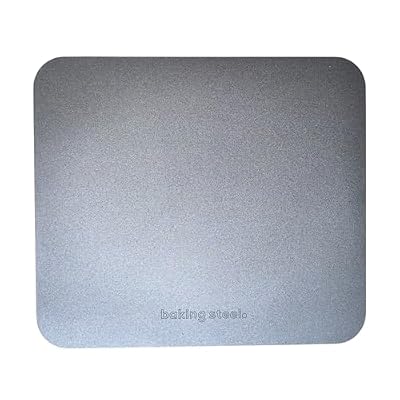
Original Baking Steel
6.4 mm is the home compromise: enough stored heat to bake two pies back to back, in a slab that will never crack the way a cordierite stone eventually does.
$139.00· as of Oct 11, 2026, 16:49 UTCCheck price on Amazon →Read the review →i
Product prices and availability are accurate as of the date/time indicated and are subject to change. Any price and availability information displayed on Amazon.com at the time of purchase will apply to the purchase of this product.
If this goes wrong
Pizza dough is too sticky to handle
Sticky is usually hydration your flour cannot absorb, gluten that has not finished forming, or a dough that has got too warm. Weigh your water, give it time and folds, and handle it with wet hands and a scraper instead of more flour.
Pizza base is soggy in the middle
Not enough heat is reaching the centre of the base fast enough to drive the water out before the crust sets. Bake on a fully preheated steel or stone rather than a tray, give it 45–60 minutes at maximum, and cut the water you put on top.
Pizza crust is dense and bready, not chewy
Dense crust means the gas never got in or never got out of the dough into the crumb. Proof to the peak, keep the rim untouched, stop adding bench flour, and bake on a surface hot enough to give you real oven spring.
Try another recipe
We have 33 recipes across 7 pizza styles. Something didn't work? Check our troubleshooting guide.