
Korean sweet potato pizza
Sweet-potato mousse and cubes, the one thing two unrelated Seoul chains agree on — with a real mousse sub-recipe and a plain admission that the cheese and the sauce below it are derived, not documented.
Recipe by ThePizzaPlanet.com · Published
Essential tool for this bake
Sweet potato pizza is a standing menu item at two unrelated Seoul chains, and this is the thinnest of the three fusion recipes in this run — a companion to Korean bulgogi pizza in the site's fusion collection, but built on less. King Arthur Bread Flour carries this pan crust the same 12.7%-protein way it carries every other pan recipe here, which matters more when the topping is a dense purée rather than a thin tomato sauce. If the middle stays pale, see a soggy base; if the cheese browns before the base is done, see cheese burning early; if the bake goes patchy under a thicker layer, see uneven cooking.
Where this comes from
Two chains, two companies, two domains — the bar this site sets for calling something a documented style rather than an invented one. This one clears that bar on a single point, and nothing else — one of three styles gathered at the Korea hub alongside bulgogi and potato pizza.
Domino's Korea sells 우리 고구마 (Woori Goguma / "Our Sweet Potato") at web.dominos.co.kr. Its page states one line: #고구마 큐브&무스가 듬뿍! — "sweet-potato cubes & mousse, generously." That is a tagline, archived on 2026-08-27, and it is the whole of what the page says about what is on the pizza.
Mr. Pizza sells 스윗고구마 (Sweet Goguma) at mrpizza.co.kr, and it is the fuller of the two sources: 달콤하고 부드러운 고구마 무스와 고구마 큐브를 아낌없이 담은 고구마 듬뿍 피자 — "a pizza generously filled with sweet, soft sweet-potato mousse and sweet-potato cubes." Three crust options are listed beside it, but the topping description stops there.
Neither chain states a cheese. Neither chain states a sauce. The only thing both pages confirm, independently, is sweet potato in two textures — a mousse and a cube — layered on the same pizza. Everything below the sweet potato in this recipe, from the mozzarella to the absence of tomato sauce, is derived from that gap rather than read off either page, and it is written that way on purpose rather than dressed up as more than it is.
What makes it that style
The one confirmed decision is mousse-and-cubes: a smooth sweetened purée doing the sauce's job and roasted chunks doing the topping's job, both cut from the same vegetable rather than sweet potato appearing once in a single form. That pairing, not any particular sauce or cheese, is what the two Seoul menus actually agree on.
A dense sweetened purée works as a sauce layer for the same reason the tomato guide gives for why plum tomatoes make a better base than round ones: it is free water, not flavor, that decides whether a topping soaks a crust or sits on top of it. A well-reduced, well-blended sweet potato mousse is mostly starch and fiber with very little liquid to give up, so it behaves like a thick sauce rather than a wet vegetable — it does not weep into the dough the way raw shredded sweet potato or a thin syrup would.
The "no tomato sauce" reading is an inference, not a quoted fact — neither page mentions tomato sauce at all, for or against, and both list this item under a sweet or specialty category rather than their classic tomato lineup. That absence is suggestive, not stated, and it is treated as an inference here rather than as anything either chain actually said. The mozzarella carries the same caveat: it is this site's default cheese for a pan crust, chosen for consistency with every other recipe here, not a documented ingredient of either Seoul pizza.
Flour: King Arthur Bread Flour (12.7% protein) — read the review
Dough Formula
| Ingredient | Grams | Baker's % |
|---|---|---|
| Flour (12.7% protein) | 218 g | 100.0% |
| Water | 131 g | 60.1% |
| Salt | 4.4 g | 2.0% |
| Yeast | 1.1 g | 0.5% |
| Oil | 11 g | 5.0% |
| Sugar | 4 g | 1.8% |
Makes 1 ball of ≈370 g
Ingredients
Dough
- Pizza dough (see formula above) — One 30 cm round pan's worth1 ball
- Olive oil for the pan — The base fries in it, same as any pan pizza20 ml
Sweet potato mousse
- Sweet potato, peeled and cubed450 g
- Heavy cream or whole milk45 ml
- Saltpinch
Toppings
- Sweet potato, peeled and cut into 1 cm cubes — A separate batch from the mousse — the two textures are the whole point200 g
- Neutral oil, for roasting the cubesdrizzle
- Low-moisture mozzarella — Cubed, not shredded — pre-shredded is coated in starch. Neither source names this cheese; it is this site's default, not a documented one200 g
- Toasted sesame seeds — For garnishpinch
Instructions
- 1
Whisk the yeast into the flour. Add water at 30-32°C (86-90°F) and the olive oil, and stir with a spatula until no dry flour remains, about a minute.
💡 Warm water carries this dough through its rise on its own — cold tap water can add hours.
- 2
Sprinkle the salt over the top, cover the bowl, and rest 20 minutes before touching it again. Do four sets of stretch-and-folds in the bowl, 30 minutes apart, with a wet hand.
- 3
Steam or boil the 450 g of mousse sweet potato until a knife slides in with no resistance, 15-20 minutes. Drain well, then blend hot with the cream and a pinch of salt until completely smooth — no fibrous strings left. Set aside to cool; it thickens as it does.
💡 This ratio is a derivation, not a documentation — neither chain publishes what goes into its mousse beyond the word itself. Blending it hot and smooth, with barely any liquid, is what keeps it dense enough to hold as a sauce layer rather than soak into the dough.
- 4
Toss the 200 g of cubed sweet potato in the neutral oil and roast at 220°C (430°F) on a tray until the edges caramelise and a knife meets no resistance, about 20 minutes. Set aside — these stay whole; they do not go into the mousse.
- 5
Cover the dough and leave at room temperature until airy, jiggly and roughly doubled, 1-1.5 hours after the last fold.
- 6
Pour the olive oil into the 30 cm pan and swirl it up the sides. Tip the dough in, turn it once to coat, and press it gently toward the edges.
💡 If it springs back before it reaches the rim, stop and wait 15 minutes. It will get there on its own.
- 7
Cover and proof in the pan 60-90 minutes, until the dough fills the pan and the surface is covered in small bubbles.
- 8
Heat the oven to 260°C (500°F) with a steel or stone on the lowest rack for at least 45 minutes.
- 9
Dimple the dough with oiled fingertips and spread the cooled mousse over it as the sauce layer, right to the edge. Scatter the mozzarella, then the roasted sweet potato cubes.
💡 The mousse is standing in for tomato sauce because neither source names one — not because either chain said to leave it out.
- 10
Bake 15-18 minutes on the steel, until the cheese at the rim is deep brown and the base lifts on a spatula with a stiff, crackling edge.
- 11
Slide onto a rack, scatter with sesame seeds, wait 5 minutes, then cut.
Tips
- →The mousse must be blended smooth and used barely warm or cooled — a lumpy or runny mousse behaves like a wet vegetable, not a sauce, and the base pays for it.
- →Cube the mozzarella. Shredded cheese has anti-caking starch that goes greasy and grainy.
- →Roast the topping cubes separately from the mousse batch. One vegetable, two preparations, is the actual style — collapsing them into one loses the point.
Video by Angie's Table · 9.7K views · 9 min · on YouTube
Shop this bake
Flour

King Arthur Bread Flour
The first bag to buy if you bake in a domestic oven. At 12.7% protein with added amylase on the label it gives you chew and colour at 250 °C, which is exactly what an unmalted 00 will not.
Check price on Amazon →Read the review →Ingredient

Polly-O Low Moisture Whole Milk Mozzarella
Thick enough to cube for a Detroit rim, where shreds burn to lace — and four ingredients against a coating of rice flour, cellulose and natamycin that no bake removes.
Check price on Amazon →Read the review →Ingredient

SAF Instant Yeast
Instant, so it goes in dry with the flour: no warm-water step means no step at which the yeast can be cooked, which is where an active-dry dough most often dies.
Check price on Amazon →Read the review →Equipment
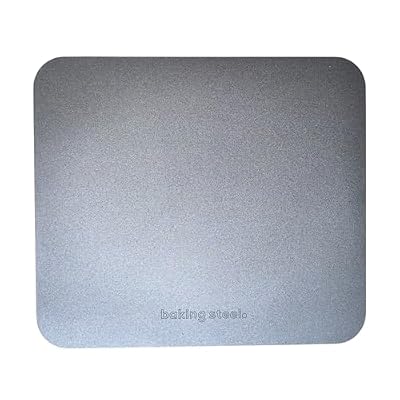
Original Baking Steel
6.4 mm is the home compromise: enough stored heat to bake two pies back to back, in a slab that will never crack the way a cordierite stone eventually does.
Check price on Amazon →Read the review →Equipment

Greater Goods Single Sensor Baking Scale
One model behind one listing, on the maker's own page: 5 kg (11 lb) of capacity, reading down to 1 g. What the listing sends is what the maker documents — rarer here than it ought to be.
Check price on Amazon →Read the buying guide →
If this goes wrong
Pizza base is soggy in the middle
Not enough heat is reaching the centre of the base fast enough to drive the water out before the crust sets. Bake on a fully preheated steel or stone rather than a tray, give it 45–60 minutes at maximum, and cut the water you put on top.
Cheese burns before the base cooks
The top of your oven is running far ahead of the bottom. Get the slab hotter so the base needs less time, move the pizza down away from the grill element, and use a whole-milk low-moisture mozzarella — it carries more fat and browns more slowly than part-skim.
Pizza cooks unevenly (one side burns)
No oven heats evenly across its floor, and the pizza does not move on its own. Find your hot spot, centre the slab with a gap all round for air to circulate, and turn the pizza 180° at roughly 60% of the bake.
More Pan Recipes
Try another recipe
We have 33 recipes across 7 pizza styles. Something didn't work? Check our troubleshooting guide.