

72-hour cold-ferment Neapolitan
Three days at 3-4°C on a tenth of a percent of yeast. The slow route to a sweet, blistered cornicione and the leoparding a same-day dough never gives you.
Recipe by ThePizzaPlanet.com · Published
Essential tool for this bake
Three days is not flavour theatre. At 0.1% instant yeast and 3-4°C, the dough ferments so slowly that enzymes have time to break starch into sugars faster than the yeast can eat them, and those leftover sugars are what give you leoparding in ninety seconds instead of a flat tan crust. That is the entire mechanism, and our cold-fermentation guide has the longer version. The risk sits on the other side of the same curve: leave the balls a day too long, or let the fridge run warm, and the gluten quietly gives up — dough that went slack is the failure this window invites most often, and it usually traces back to an unmeasured fridge. Buy a thermometer and check the shelf you really use. Caputo Chef's Flour at 13% protein is built for this window; a softer 00 will not hold up for 72 hours. Two hours at room temperature before you stretch, and handle the rim like it is full of something you don't want to spill.
Flour: Caputo "00" Chef's Flour (blue bag) (13% protein) — read the review
Dough Formula
| Ingredient | Grams | Baker's % |
|---|---|---|
| Flour (13% protein) | 600 g | 100.0% |
| Water | 390 g | 65.0% |
| Salt | 17 g | 2.8% |
| Yeast | 0.6 g | 0.1% |
Makes 4 balls of ≈252 g
Ingredients
Dough
- Pizza dough (see formula above) — Balled after a 2-hour bulk, then 72 hours at 3-4°C (37-39°F)4 balls
Sauce
- San Marzano tomatoes (whole, canned) — Hand-crushed, never blended400g
- Fine sea salt3 g
- Fresh basil leaves — Torn into the raw sauce4 leaves
Toppings
- Fior di latte — Torn and drained 30 min on a rack over a tray280g
- Extra virgin olive oildrizzle
- Fresh basil — Added after the bakehandful
Instructions
- 1
Dissolve the 0.6 g of instant yeast in the water. Weigh it on a scale that reads to 0.1 g — if yours only reads to 1 g, whisk 1 g of yeast into 9 g of flour and use 6 g of that mix.
💡 A tenth of a percent is not a rounding error, it is the recipe. Guessing here is how a 72-hour dough turns into a 36-hour dough.
- 2
Add about 80% of the flour and mix to a smooth batter, then add the salt, then the rest of the flour. Mix until there is no dry flour left.
- 3
Knead 10-15 minutes by hand, resting 5 minutes in the middle, until the dough is smooth, tight and passes a windowpane test.
💡 Cold fermentation does not build gluten for you at this yeast level. The structure has to come from the knead.
- 4
Bulk ferment covered at room temperature for 2 hours. The dough will barely move. That is expected — you are only waking the yeast up.
- 5
Divide into four 252 g balls, shape each one tight with a smooth top, and put them in lidded containers with room to double.
💡 Ball tightly now. Seventy-two hours of relaxation will undo a lazy ball and leave you with a flat, sticky disc on day three.
- 6
Refrigerate 72 hours at 3-4°C (37-39°F). Check the actual shelf temperature with a thermometer, not the dial on the door.
💡 Above 6°C (43°F) the dough will be past its peak by day three. Below 2°C (36°F) almost nothing happens and you get a three-day-old same-day dough.
- 7
Take the balls out 2 hours before you bake and leave them covered at room temperature until they are relaxed and slightly domed, at 18-20°C (64-68°F).
💡 Two hours is a floor, not a target. In a cold kitchen give them three.
- 8
Heat a wood or gas oven to 430-480°C (805-895°F). At home, run a baking steel on the top rack under the broiler for 45-60 minutes.
💡 Leoparding needs floor heat and a hot ceiling at the same time. A steel under a broiler is the closest a home oven gets.
- 9
Crush the tomatoes by hand, stir in the salt and torn basil, and leave the sauce raw.
- 10
Open a ball into a 30 cm round on a floured bench, pressing from the centre out and leaving the outer 2 cm untouched. Never use a rolling pin.
💡 The rim is where three days of fermentation cash out. Press the gas into it, not out of it.
- 11
Sauce in a thin spiral, mozzarella torn over in six or seven pieces, a drizzle of oil. Keep it light — a heavy pizza will not puff.
- 12
Launch and bake 60-90 seconds in a pizza oven, turning every 20 seconds. At home, 4-6 minutes on the steel with the broiler on for the last 2 minutes.
- 13
Slide onto a rack, add fresh basil, and eat it standing up within a minute of it leaving the oven.
Tips
- →The calculator's Neapolitan timeline defaults to a 24 h cold ferment; this recipe deliberately runs 72 h for a sweeter, more blistered crust — use the calculator link above for the dough formula, not its default schedule.
- →Hands-on time is about 30 minutes spread across three days. Everything else is the fridge doing the work.
- →Weigh the yeast on a 0.1 g scale. At this dose, guessing changes the recipe.
- →Measure your fridge, not your fridge's dial — the shelf you use is usually 2°C off the setting.
- →Day 3 is the target, but the dough is good from day 2. Past day 4 it goes slack.
- →Warm the balls fully. Cold dough tears at the rim and stays pale in the oven.
- →Drain the mozzarella on a rack for a full 30 minutes or you will steam the middle.
Video by Baking Steel · 166K views · 7 min · CC · on YouTube
Shop this bake
Flour

Caputo "00" Chef's Flour (blue bag)
Buy the blue bag if you cold-ferment 24–72 hours. It is the 00 that survives a long ferment, which is also what lets it brown in a home oven.
Check price on Amazon →Read the review →Ingredient

La Valle San Marzano D.O.P. Whole Peeled Tomatoes
The consortium's protected-origin mark: variety and ground audited. The catch is that La Valle publishes no product page, so the mark is read off the tin and the listing, not a maker's record.
Check price on Amazon →Read the buying guide →Ingredient

SAF Instant Yeast
Instant, so it goes in dry with the flour: no warm-water step means no step at which the yeast can be cooked, which is where an active-dry dough most often dies.
Check price on Amazon →Read the review →Equipment
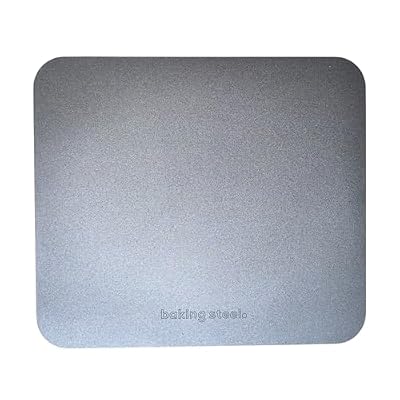
Original Baking Steel
6.4 mm is the home compromise: enough stored heat to bake two pies back to back, in a slab that will never crack the way a cordierite stone eventually does.
Check price on Amazon →Read the review →Equipment

Brod & Taylor Proofing Container
A 32.5 × 26.5 cm footprint only 10 cm deep (12.8 × 10.5 × 4 in) — a published figure, so you can measure the shelf and the depth before you commit to either.
Check price on Amazon →Read the buying guide →Equipment

Greater Goods Single Sensor Baking Scale
One model behind one listing, on the maker's own page: 5 kg (11 lb) of capacity, reading down to 1 g. What the listing sends is what the maker documents — rarer here than it ought to be.
Check price on Amazon →Read the buying guide →Equipment

Etekcity Lasergrip 1080 Infrared Thermometer
Emissivity adjustable from 0.1 to 1.0 is the line between an instrument and an ornament, and the cheaper guns in this class are fixed at one value.
Check price on Amazon →Read the review →
If this goes wrong
Cold-fermented dough went slack and won't hold shape
The ferment ran past what your flour can carry and enzymes have cut the gluten. Chill the dough hard, re-ball it gently to rebuild tension, rest 40 minutes, and bake it thinner — then match flour strength and yeast dose to the length of the ferment.
Pizza dough over-proofed (smells of alcohol)
The yeast has run through its sugars and enzymes are now cutting the gluten faster than it can hold. Get the dough cold immediately, re-ball it to rebuild what structure is left, and bake it within the hour.
No leopard-spotting on the cornicione
Leopard spots are charred bubble tops, not browning, and charring needs a floor around 400 °C (750 °F) plus a well-fermented dough. In a home oven you can approximate it with a steel on the top rack and the grill flat out — true leoparding needs a pizza oven.
More Neapolitan Recipes
Try another recipe
We have 33 recipes across 7 pizza styles. Something didn't work? Check our troubleshooting guide.