
Can an Electric Pizza Oven Run on a 15-Amp Kitchen Outlet?
Usually yes, on its own — most high-heat electric pizza ovens draw close to or at the full 15 A an older kitchen circuit carries, though newer kitchens typically wire countertop outlets at 20 A. Here is the arithmetic and how to check your own panel.
By ThePizzaPlanet.com · Published
On This Page
Top pick
The short answer
Yes, on a 15 A circuit by itself — every oven on the indoor hub draws at or under 15 A at its published wattage, so plugged into a dedicated outlet with nothing else running on the same circuit, none of them should trip a correctly rated 15 A breaker. The real risk is a shared circuit: a kettle, a microwave or a toaster drawing current on the same breaker while the oven runs can push the combined load past what the circuit is built to carry, and that is what actually trips most breakers in a kitchen.
The 15 A figure itself is the older or more limiting case, not a universal one. Texas's residential electrical code — based on the National Electrical Code that most US jurisdictions adopt — requires at §E3703.2: "A minimum of two 20-ampere-rated small-appliance branch circuits shall be provided" for kitchen countertop receptacles. A kitchen wired or rewired to that newer rule has more headroom per circuit than the 15 A arithmetic below assumes, so the single most useful thing to do before anything else here is check the breaker labeled for the outlet in question — many panels print the amperage right on the breaker switch — rather than assume 15 A.
Watts to amps
A standard US or Canadian household circuit runs at 120 V, and the basic power relation gives the rest: power equals voltage times current (P = V × I), so current equals power divided by voltage — amps equal watts divided by volts. A 1,800 W appliance on a 120 V circuit draws 1,800 ÷ 120 = 15.0 A — exactly a 15 A circuit's rated maximum, with nothing left over for anything else on that breaker. That one calculation is the entire basis for everything on this page; nothing here is more complicated than that division.
Why a shared circuit trips
A circuit breaker is not meant to run at its full rated current indefinitely. Texas's residential electrical code — which, like most US jurisdictions, adopts the National Electrical Code's wiring rules — states the underlying rule at §E3701.2.1: "Where a branch circuit or feeder supplies continuous loads or any combination of continuous and noncontinuous loads, the minimum branch-circuit or feeder conductor size shall have an ampacity not less than the noncontinuous load plus 125 percent of the continuous load." Sizing the wiring at 125% of a continuous load is the same rule stated the other way around: a continuous load (one running 3 hours or more, which a 15–20 minute pizza bake usually is not, but a long preheat plus several bakes back-to-back can approach) should not exceed about 80% of the circuit's rated capacity — which puts a 15 A circuit's comfortable continuous ceiling closer to 12 A rather than the full 15. A bake usually is not a continuous load in that sense, so a 14–15 A oven stays within the breaker's own rating; what it does leave is almost no headroom for anything else sharing the same circuit.
This is why the question is rarely "will the oven trip the breaker" and almost always "will the oven plus whatever else is already running on that circuit." A kettle drawing roughly 1,500 W (12.5 A) switched on while a 1,700 W oven (14.2 A) is preheating adds up to 26.7 A on a circuit rated for 15 — well past the point of tripping, and nowhere close to a subtle problem. Microwaves, toasters and coffee makers all draw enough on their own to cause the same stacking effect, and kitchen circuits are exactly where multiple high-draw appliances are most likely to share one breaker.
How to find a circuit with headroom
Most homes wire a run of countertop outlets to the same breaker, so the outlet right next to the one the oven is plugged into may share its circuit rather than have one of its own. A panel directory that labels circuits by room rather than by outlet will not tell you this on its own. The practical way to check: plug a lamp or any obviously powered device into each nearby outlet, then switch breakers off one at a time at the panel and note which outlets go dark together — the ones that go dark at the same time share a circuit.
Once a shared group is identified, the fix is usually just rearranging which outlet other appliances use while the oven runs, rather than anything involving the wiring itself: move the kettle and the toaster to an outlet on a different circuit, and leave the oven's outlet for the oven alone during a bake. If no outlet in reach of the oven has free headroom on its own circuit, that is the point where a dedicated circuit becomes worth asking about rather than working around.
What each indoor oven draws
Amps are current divided from each maker's published wattage (watts ÷ 120 V), rounded to one decimal place — none of the manufacturers below publish an amp figure directly.
| Oven | Watts | Amps (120 V) | |---|---|---| | Breville Smart Oven Pizzaiolo | 1800 W | 15.0 A | | Chefman High-Heat Indoor Electric Pizza Oven | 1700 W | 14.2 A | | Ooni Volt 12 | 1600 W | 13.3 A | | Presto Pizzazz Plus | 1235 W | 10.3 A |
None of these draws is a continuous load in the sense the 80% rule above addresses — a bake is minutes, not hours — so the 15 A rating itself is the number each oven needs to stay under, and all four do. What the table does show is how much headroom is left on the same circuit for anything else running at the same time: the Breville leaves essentially none (15.0 of 15 A used), the Chefman and the Ooni Volt leave 0.8 A and 1.7 A respectively, and only the Presto, at 10.3 A, leaves enough spare capacity (4.7 A) for something else small to share the outlet without pushing past the rating. None of this is a safety defect in any of these ovens — a correctly rated 15 A breaker is built to carry up to 15 A, and each of these draws at or under that on its own.
Wiring changes — adding a dedicated circuit, upgrading a breaker, or running a new outlet — are a job for a licensed electrician, not something to attempt from a spec sheet. This page is arithmetic and a checklist for finding an outlet with headroom, not electrical advice.
Ovens mentioned
- Check price on Amazon →

Breville Smart Oven Pizzaiolo (BPZ820)
$999.95· as of Oct 11, 2026, 16:49 UTCi
Product prices and availability are accurate as of the date/time indicated and are subject to change. Any price and availability information displayed on Amazon.com at the time of purchase will apply to the purchase of this product. - Check price on Amazon →

Ooni Volt 12 Electric Pizza Oven
- Check price on Amazon →

Chefman High-Heat Indoor Electric Pizza Oven
$299.99· as of Oct 11, 2026, 16:49 UTCi
Product prices and availability are accurate as of the date/time indicated and are subject to change. Any price and availability information displayed on Amazon.com at the time of purchase will apply to the purchase of this product. - Check price on Amazon →
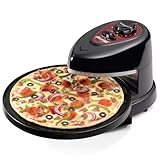
Presto Pizzazz Plus Rotating Oven
$87.69· as of Oct 11, 2026, 16:49 UTCi
Product prices and availability are accurate as of the date/time indicated and are subject to change. Any price and availability information displayed on Amazon.com at the time of purchase will apply to the purchase of this product.
Put it into practice
Recipes
Troubleshooting
Ready to make pizza?
Use our calculator for exact dough measurements — and if something goes wrong, troubleshoot it by symptom.